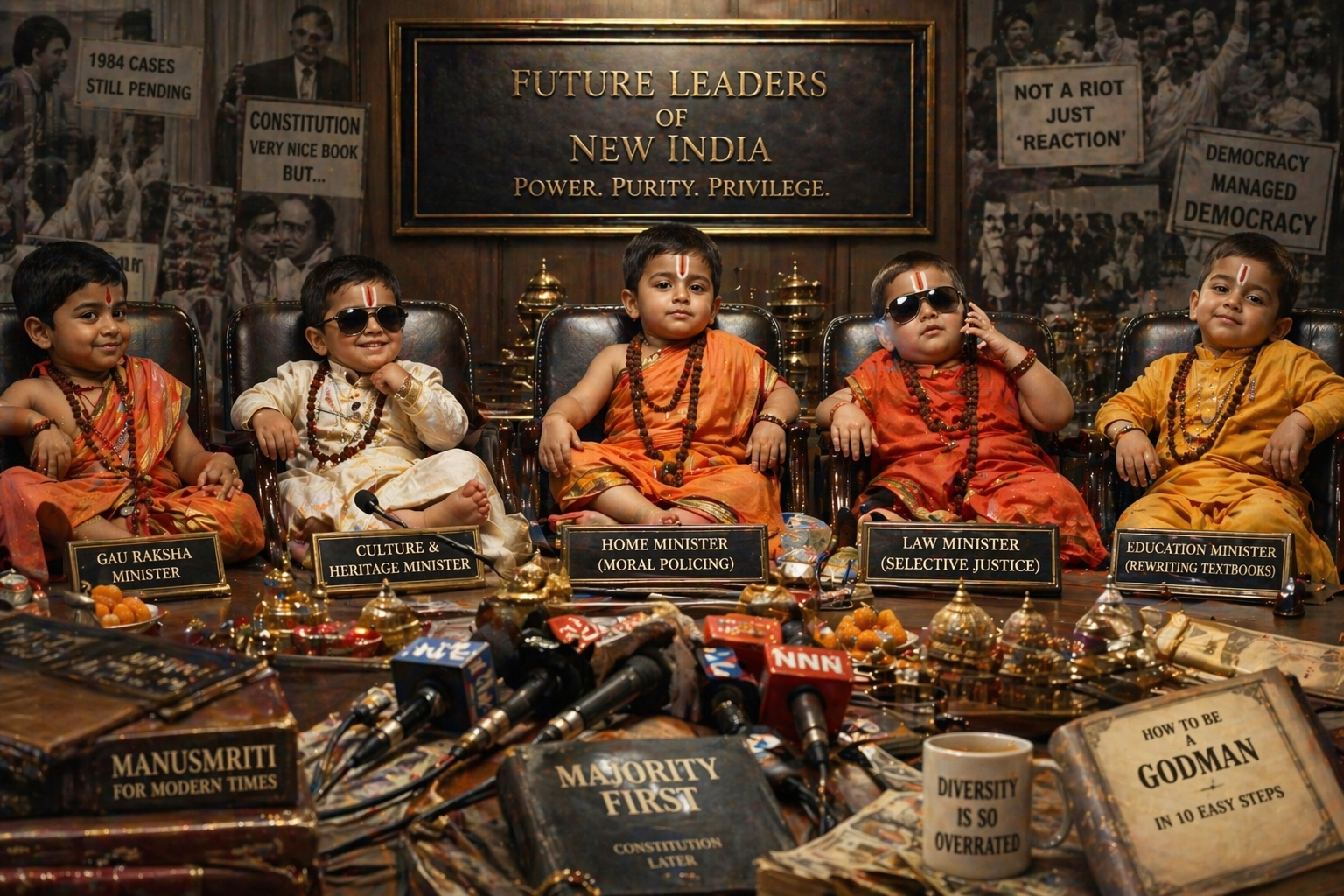
He is seven years old. He cannot read a legal contract, cannot explain a mortgage, and probably still needs help organizing a school bag. Yet adults travel long distances to touch his feet, seek his blessing, and ask him to heal illness, fix marriage, rescue business, or reverse fate itself. He is presented not as a child with a future, but as a finished authority with a supernatural one. That should disturb any society that claims to care about either children or reason.
This is not merely a remote-village curiosity. In the smartphone era, the child baba is a scalable product. The spectacle moves through temple compounds, roadside gatherings, livestreams, YouTube channels, WhatsApp forwards, and a steady market of offerings, access, and devotional circulation. Adults cry. Adults kneel. Adults donate. Adults manage the camera angles. The child performs holiness before they are old enough to consent to performance at all.
The most troubling fact is not that human beings believe. Human beings have always believed. The troubling fact is that adults are willing to use a child to manufacture belief at scale.
The Phenomenon: What a "Child Baba" Actually Is
Across parts of India, a familiar script repeats itself. A child is declared a divine incarnation, a reincarnated saint, or a vessel of special power. The child is dressed in robes, seated above adults, spoken for by handlers, and presented for darshan. The public is invited to see innocence and interpret it as sanctity. The child becomes a site of projection onto which adults pour fear, hope, grief, and money.
The structure matters. The child is not usually operating alone in some mystical vacuum. There is almost always an adult ecosystem around the figure: family members, local enforcers, devotional entrepreneurs, access controllers, fundraisers, and now digital distributors. Once the myth stabilizes, the child is no longer just a child. They become a platform.
That is why the phenomenon is best understood not as an oddity but as a public institution of informal authority. It combines religion, commerce, spectacle, and emotional need. It is not ancient tradition in its pure form. It is tradition processed through modern media and audience economics.
How The Operation Works
The central figure is presented as divine, spiritually gifted, or beyond ordinary human development.
Adults manage access, myth, scheduling, and money while the child bears the public role.
Faith is monetized through gifts, ritual access, private audiences, media circulation, and prestige.
Social media converts local charisma into a repeatable and expandable devotional market.
Why Adults Believe
Mockery is an easy substitute for analysis. It is also intellectually lazy. People do not fall into miracle markets because they lack a gene for reason. They fall into them because reason competes badly against desperation, authority, community pressure, and the emotional appeal of innocence.
Mechanism One
Precarity Creates Demand for Wonder
Illness, debt, crop failure, unemployment, and bureaucratic neglect create a market for certainty. When institutions do not work, miracles become a parallel service sector.
Mechanism Two
Authority Bias Does the Rest
Once a local elder, priest, or community broker certifies the child as special, dissent becomes socially expensive. Belief is often a collective performance before it becomes a private conviction.
Mechanism Three
Innocence Is Misread as Sanctity
Children are seen as pure and uncorrupted, and purity is then translated into divine proximity. The emotional shortcut is ancient. The commerce built on it is very modern.
Mechanism Four
Community Often Punishes Skepticism
In tightly bound settings, refusing the miracle can mean refusing the community around it. Skepticism is not only cognitive work. It is social risk.
The Exploitation: Who Actually Benefits
The critical question is not whether every believer is cynical. Many are not. The sharper question is who materially benefits from the arrangement. The answer, in case after case, is not the child.
The child loses ordinary life first. Schooling becomes irregular or symbolic. Friendships shrink. Privacy vanishes. Performance replaces play. A personality that is still forming is forced into the rigid mold of public authority. Children are not allowed the ordinary dignity of experimentation and error; they are compelled to inhabit an identity authored by adults.
The Structure of a Child Baba Enterprise
Researchers and rationalist observers repeatedly describe a similar setup. At the center sits the child. Around the child sits an adult ring: relatives who act as managers, loyalists who regulate access, collectors who handle offerings, and local promoters who keep the story circulating.
What the public sees is devotion. What often exists behind that devotion is a simple administrative fact: a child has become the revenue-bearing face of an adult-run operation.
Even where direct profiteering is harder to document, symbolic capital is obvious. Influence, status, local power, and control over devotees collect around the adults nearest to the miracle.
In secular terms, this is exploitation before it is theology. The child is being used to anchor a public economy of access, reverence, and dependence. If the same degree of pressure, isolation, and labor were imposed in a nonreligious industry, the moral vocabulary would become much less evasive.
Dr. Narendra Dabholkar spent his life insisting that miracles have mechanisms. He was killed for that insistence. That alone tells you how much social power is at stake when belief is examined instead of revered.
The Real Cost: Science, Development, and Lost Futures
India's paradox is now familiar. It has a world-class space program, major scientific institutions, deep technical talent, and a constitutional vocabulary that explicitly honors scientific temper. It also remains a country in which miracle markets flourish wherever public reasoning is weak and public services are unreliable.
The contradiction is not unique to India. Every society that produces advanced science also produces zones of magical thinking. The issue is not civilizational purity. The issue is balance. Which mode of thought is actually winning in the daily decisions of ordinary families: evidence, or performance dressed as faith?
Education
The School System Rarely Trains Skepticism
Science is often taught as content to memorize rather than as a habit of questioning, testing, and revising belief.
Media
Spectacle Outcompetes Reason
Miracle clips travel faster than careful explanation because spectacle is emotionally efficient and platform-friendly.
Law
The Legal Vacuum Protects the Adults
Most jurisdictions have little to say specifically about the commercial use of children as religious authority figures, which means intervention is piecemeal and late.
Health
Delayed Treatment Carries Real Cost
Every rupee and every hour routed toward ritual cure rather than evidence- based care increases the chance that preventable suffering becomes fatal.
India Does Not Need Imported Skepticism
One of the laziest responses to rationalist criticism is to pretend that skepticism is somehow alien to India. It is not. The subcontinent contains long and serious traditions of doubt, materialism, inquiry, and anti-superstitious reform.
The Charvaka tradition rejected scriptural authority and insisted on empirical verification. Buddhist sources repeatedly warned against passive belief without investigation. In modern politics, Periyar attacked caste superstition and religious hierarchy with relentless force. Ambedkar, the architect of the Constitution, regarded social reform and rational critique as inseparable from human dignity. Nehru treated scientific temper as central to modern citizenship.
The rationalist argument therefore does not need foreign permission. It already belongs to India.
What Would Actually Help
Better science education. Better child-protection enforcement. Better public healthcare. Better media literacy. Better legal tools against exploitative miracle commerce. And above all, stronger public institutions so families do not have to choose between bureaucratic failure and supernatural theater.
The Child at the Center
Return, finally, to the child on the throne. Whatever one thinks about metaphysics, one fact is beyond dispute: the child did not meaningfully choose the role. Children cannot consent to becoming public instruments of adult faith, adult revenue, or adult prestige.
That is what makes the phenomenon morally ugly even when it is wrapped in soft language about devotion. The question is not whether every believer is wicked. Most are not. The question is whether a society that claims to respect children can tolerate adults turning childhood itself into a devotional asset class.
In a country that launches missions to the moon, trains world-class engineers, and constitutionally honors the scientific temper, the sight of desperate adults queueing before a child marketed as miraculous is not just melancholy. It is an index of unfinished democratic and intellectual work.
The answer is not contempt for believers. The answer is schools that teach how to think, institutions that reduce desperation, laws that protect children, and a public culture brave enough to call exploitation by its proper name even when it arrives in saffron robes.