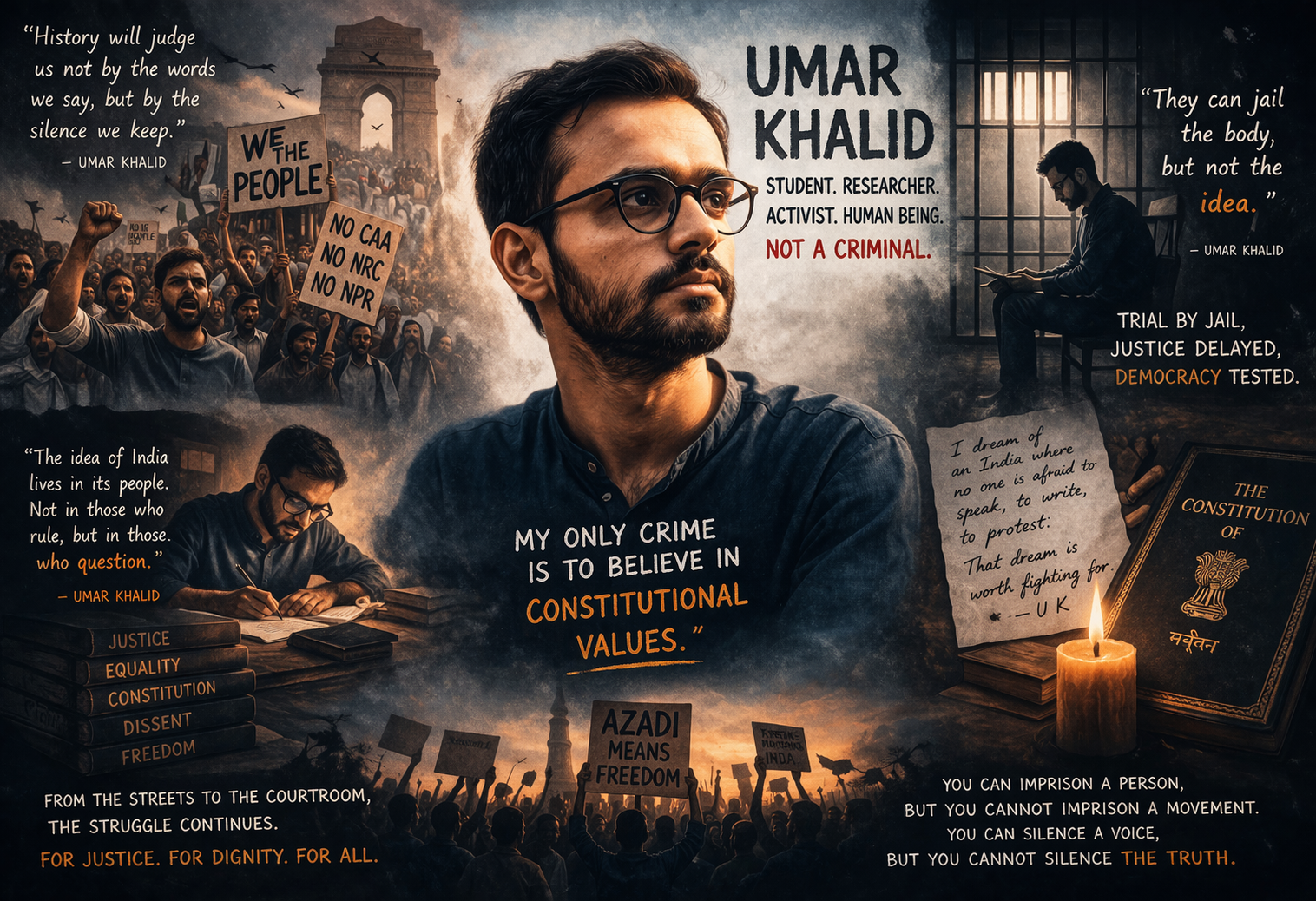
Core claim: Umar Khalid's case is no longer just about one accused person. It is one of the clearest modern examples of how India's anti-terror bail system can turn accusation into years of incarceration before a real trial begins.
Executive Summary
Umar Khalid is a former Jawaharlal Nehru University student activist whose public life has been shaped by repeated conflict with the criminal-legal system. He first became nationally visible during the 2016 JNU sedition episode. But the case that now defines him is much larger: his arrest in September 2020 in the Delhi riots "larger conspiracy" case under the Unlawful Activities (Prevention) Act, or UAPA.
As of April 4, 2026, he remains in Tihar Jail as an undertrial prisoner. His regular bail was rejected by the trial court, then by the Delhi High Court in 2022, then again after a second round of litigation in 2025, and finally by the Supreme Court of India on January 5, 2026. In that January 2026 judgment, the Supreme Court denied bail to Khalid and Sharjeel Imam while granting bail to five co-accused.
The legal issue is straightforward. Once a court says the accusations under UAPA appear "prima facie true," Section 43D(5) makes bail extremely hard to get. At that stage the court is not testing the evidence the way a trial would. It is mainly asking whether the prosecution story, taken at face value, clears the statutory threshold.
That is why this case matters far beyond Khalid himself. Critics say it shows how:
- a very broad conspiracy theory can swallow protest activity,
- protected witness statements can carry enormous weight before cross-examination,
- delay in trial can coexist with continued detention,
- and anti-terror law can be used in a way that turns the process itself into punishment.
Amnesty International, Human Rights Watch, and the International Commission of Jurists have all treated the case as part of a broader pattern: shrinking space for dissent, selective prosecution, and a legal structure that weighs especially heavily on Muslim activists and anti-CAA organizers.
From Campus Dissent to the UAPA Dock
Khalid's public profile first rose during the 2016 JNU sedition controversy, when he became one of the most visible student activists in a national debate over dissent, nationalism, and state power. That episode mattered because it introduced a theme that has followed him ever since: political speech being treated not merely as opposition, but as a security problem.
By late 2019 and early 2020, he was part of a broader protest climate against the Citizenship Amendment Act and the proposed NRC. Those protests were not marginal. They were one of the biggest civic mobilizations India had seen in years. They were also politically explosive because they challenged a BJP-led government on a question that cut directly into citizenship, religious identity, and the place of Muslims in the republic.
The state's answer, in the most controversial cases, was not limited to crowd control or ordinary criminal law. It moved toward conspiracy, anti-terror statutes, and narrative escalation. In Khalid's case, the prosecution theory became that anti-CAA organizing was not simply protest that later spiraled out of control. It was, the state said, part of a planned operation that used protest sites, speeches, WhatsApp groups, and coordinated road blockades as stages in a deeper conspiracy that culminated in the February 2020 violence in Delhi.
Once the case is framed that way, the legal terrain changes completely.
The Case Timeline in Plain Language
Open the timeline table
| Date | Event | Why it mattered |
|---|---|---|
| 2016-02-23 | Khalid surrenders in the JNU sedition case | This is where he first becomes nationally visible in debates on dissent and criminal law. |
| 2020-03-06 | FIR 59/2020 is registered | This becomes the "larger conspiracy" case tied to the Delhi riots. |
| 2020-09-13 | Khalid is arrested | The 2022 Delhi High Court order itself records the arrest date as 13 September 2020. |
| 2020-11-22 | Supplementary chargesheet names Khalid | He is drawn directly into the UAPA conspiracy case. |
| 2022-03-24 | Trial court rejects regular bail | The trial court finds the accusations "prima facie true" for UAPA purposes. |
| 2022-10-18 | Delhi High Court rejects bail | The High Court says it cannot conduct a mini-trial or deeply test witness credibility at this stage. |
| 2024-02-14 | Supreme Court plea withdrawn | The later High Court judgment records that the first SLP was withdrawn on change-in-circumstances grounds. |
| 2024-05-28 | Trial court rejects second bail application | This sets up the second High Court round. |
| 2025-09-02 | Delhi High Court again rejects bail | The court rejects the Vernon, parity, and continued-incarceration arguments. |
| 2026-01-05 | Supreme Court denies bail | Bail is denied to Khalid and Sharjeel Imam, but granted to five co-accused. |
Read the bail issue in ordinary language
In an ordinary criminal case, defence lawyers can often argue that the evidence is weak, that there was no recovery, no direct act, no reliable witness, or no real chance of conviction. In a UAPA case, once the court says the accusation appears "prima facie true," the room for bail narrows sharply.
That means the defence is often forced into a strange position: it says the evidence is unreliable, delayed, untested, or politically stretched, but the bail court responds that those are mostly trial questions. The trial, meanwhile, moves slowly. The accused stays in jail.
What the Courts Have Actually Said
1. Delhi High Court, 18 October 2022
The first major appellate order against Khalid is the Delhi High Court's judgment in CRL.A. 173/2022, pronounced on October 18, 2022.
The order does two things. First, it accepts the basic structure of the prosecution's story: speeches, meetings, WhatsApp groups, and protest coordination are treated as parts of a wider conspiracy linked to the violence. Second, it shows how narrow bail review becomes under UAPA. The court says it cannot conduct a mini-trial and cannot really test the veracity of the evidence at this stage. It also accepts the trial court's view that Khalid's name appears through the alleged conspiracy from its early stage to the riots themselves.
Once the court accepts the chargesheet as strong enough on paper, but refuses to test it deeply because that belongs to trial, the chargesheet begins to do more than accuse. It begins to keep the accused in prison.
2. Delhi High Court, 2 September 2025
By the time the case returns to the Delhi High Court in 2025, Khalid has already spent years in prison. The defence says three things changed:
- later Supreme Court reasoning in Vernon,
- parity with co-accused who had secured bail,
- and the sheer length of incarceration.
The High Court rejects all three.
The court says the earlier 2022 decision had already gone through the material and found a prima facie case. It notes that Khalid's first Supreme Court challenge to that 2022 order was withdrawn, that the second trial-court bail application was rejected on May 28, 2024, and that the present appeal is against that second rejection.
On Vernon, the court says that case does not help Khalid because the evidence here cannot, at this stage, be treated as weak. On parity, it says earlier bail orders for other accused cannot automatically help him. On delay, it effectively says long incarceration by itself is not enough in a UAPA case of this gravity.
The 2025 order says, in effect, that even long incarceration does not change the bail answer if the court still thinks the prosecution material clears the UAPA threshold.
3. Supreme Court, 5 January 2026
The Supreme Court's reportable judgment of January 5, 2026 is the most important document in the case so far.
The judgment does two things at once:
- it recognizes that prolonged pretrial incarceration is a serious constitutional concern,
- but still denies bail to Khalid.
The judgment says liberty under Article 21 matters, that pretrial incarceration cannot simply become punishment, and that courts must be alert to delay. But when it turns to Khalid's individual case, the Court says the prosecution material, taken at face value, attributes to him a "central and formative" role. It also says that the defence arguments, however carefully framed, would require the Court to resolve credibility disputes and competing inferences, which lies beyond the proper scope of a UAPA bail inquiry.
The Court grants bail to five co-accused but denies it to Khalid and Sharjeel Imam by distinguishing their alleged roles from the others. It then creates a limited future opening: the two can renew their bail request after the prosecution finishes examining its protected witnesses, or after one year from January 5, 2026, whichever comes earlier.
So the Court leaves Khalid in jail despite more than five years of custody, while allowing a later bail renewal at a defined stage.
Why This Looks Like Trial by Jail
Here the phrase "trial by jail" describes a concrete legal structure.
The prosecution does not need to win the case at the bail stage. It needs to persuade the court that the accusations appear strong enough on paper. The defence, meanwhile, cannot fully test witnesses, cannot cross-examine protected witnesses, cannot force a proper credibility hearing, and cannot easily convert delay into release because the statute is designed to resist that move.
That has three consequences.
The chargesheet becomes unusually powerful
In normal public understanding, a chargesheet is an accusation. In a hard-edged UAPA case, it becomes much more than that. It becomes the document that can keep a person in prison for years while the state asks for time, files supplementary chargesheets, and advances the case only slowly.
The distinction between allegation and punishment weakens
Nobody in the case has yet produced a final judgment proving Khalid's guilt. Yet the practical consequence is that he has already spent years in prison under one of the harshest legal frameworks in India. If liberty is lost for half a decade before the trial properly tests the evidence, it is hard to pretend that punishment begins only after conviction.
Delay stops helping the accused in the way ordinary readers expect
In ordinary public understanding, a slow trial should strengthen a bail claim. In UAPA practice, that often does not happen. Delay matters, but often not enough. Courts acknowledge the problem, then say the statutory threshold still governs.
That is why critics say the system is not merely strict. It is structurally tilted toward pretrial captivity.
What Rights Groups Are Saying
Human Rights Watch's work on the anti-CAA period described the violence and its aftermath as deeply shaped by anti-Muslim discrimination, inflammatory rhetoric, and serious allegations of police bias. Amnesty International has repeatedly framed Khalid's continued detention as an attack on peaceful protest, and in 2025 said his five-year imprisonment without trial made a mockery of justice. The ICJ and other groups went further in September 2025, calling for his immediate and unconditional release and explicitly describing the charges as politically motivated and spurious.
These groups are not making a narrow argument about one speech or one accused. Their argument is about pattern:
- BJP-era majoritarian politics turns Muslim dissent into a security issue;
- police and prosecutors treat protest organization as conspiracy infrastructure;
- UAPA supplies the legal hardness that ordinary criminal law might not;
- and courts, constrained by doctrine and often cautious in politically loaded cases, refuse to break the chain early.
That reading is rooted in the court record, the design of the UAPA bail regime, and sustained human-rights reporting.
Political Context
To many critics, this case looks like more than overcharging or procedural delay. It looks like a method of governance:
- ruling-party politics that frames dissent as threat,
- police that build wide conspiracy stories around protest networks,
- prosecutors that stretch anti-terror law over speech, meetings, and associations,
- and courts that insist they are only following the statute while liberty drains away year after year.
Each institution can still claim it is only doing its job. That is part of what makes this pattern hard to confront.
This is an inference from the record and rights reporting, not a judicial finding. But it helps explain why the case resonates so far beyond one defendant. The issue is not only whether Umar Khalid will eventually be convicted or acquitted. The issue is whether the Indian state has built a system in which inconvenient dissidents, especially Muslim dissidents, can be neutralized through time itself.
This is also why the minority-rights issue matters.
When the victims of communal violence are disproportionately Muslim, when major human-rights reporting says anti-Muslim discrimination shaped both the violence and the aftermath, and when Muslim protest organizers become some of the most heavily prosecuted faces of the episode, the constitutional promise of equal citizenship begins to look badly strained.
For many Indian Muslims, the warning is not abstract. The fear is that even when they are among the principal victims of majoritarian violence, the institutional afterlife of that violence can still place them in the dock first.
The Judiciary's Role
The strongest criticism is not that every judge is corrupt or that every order is politically scripted. The stronger and more defensible criticism is this:
the judiciary increasingly looks unable, or unwilling, to act as a serious early check when national-security law is used against politically inconvenient defendants.
That criticism is stronger because it follows the record.
The 2022 Delhi High Court order says credibility cannot really be tested at the bail stage. The 2025 Delhi High Court order says the later arguments on Vernon, parity, and additional incarceration still do not change the answer. The 2026 Supreme Court judgment says prolonged pretrial detention is a major constitutional concern, but still leaves Khalid in jail because the statutory threshold remains attracted.
The result is clear. The judiciary speaks the language of liberty, caution, and constitutional balance. But in cases like this, critics see a system that too often reaches the same practical end point as the executive: continued incarceration.
That is why people increasingly describe cases like Khalid's as a crisis of accountability, not just a dispute over bail.
What Still Cannot Honestly Be Claimed
The present record does not prove Khalid is innocent of everything alleged. That is not what the courts have decided, and it is not what this article can decide. It also does not follow that absence from a riot site automatically defeats conspiracy law. Indian conspiracy doctrine does not work that narrowly.
But it is equally dishonest to pretend that years of imprisonment under an anti-terror statute, before meaningful trial scrutiny of the evidence, is just routine legal process.
The present position is this:
- guilt has not been adjudicated,
- the prosecution case is still untested by a full trial,
- but the detention itself has already become a profound constitutional and human-rights issue.
That is enough to justify strong criticism, even before the final merits are known.
Conclusion
As of April 4, 2026, the legal situation is clear: Umar Khalid remains in prison, the Supreme Court has denied him bail, and the controlling judicial view is that the prosecution material still supports a prima facie case under UAPA.
This case shows how, in contemporary India:
- anti-terror law can be used to hold a dissident for years before trial,
- broad conspiracy narratives can absorb protest activity,
- constitutional concern about liberty can coexist with continued detention,
- and minority vulnerability can deepen when the state's security vocabulary overtakes the language of citizenship and dissent.
If Khalid is eventually convicted after a fair, rigorous, adversarial trial, that will settle one set of questions. If he is not, it will mean that Indian institutions kept a political dissident in prison for years on a theory they could not yet prove in open court.
The real scandal is not only what the state has alleged. It is how easily the system can make allegation itself carry the weight of punishment.