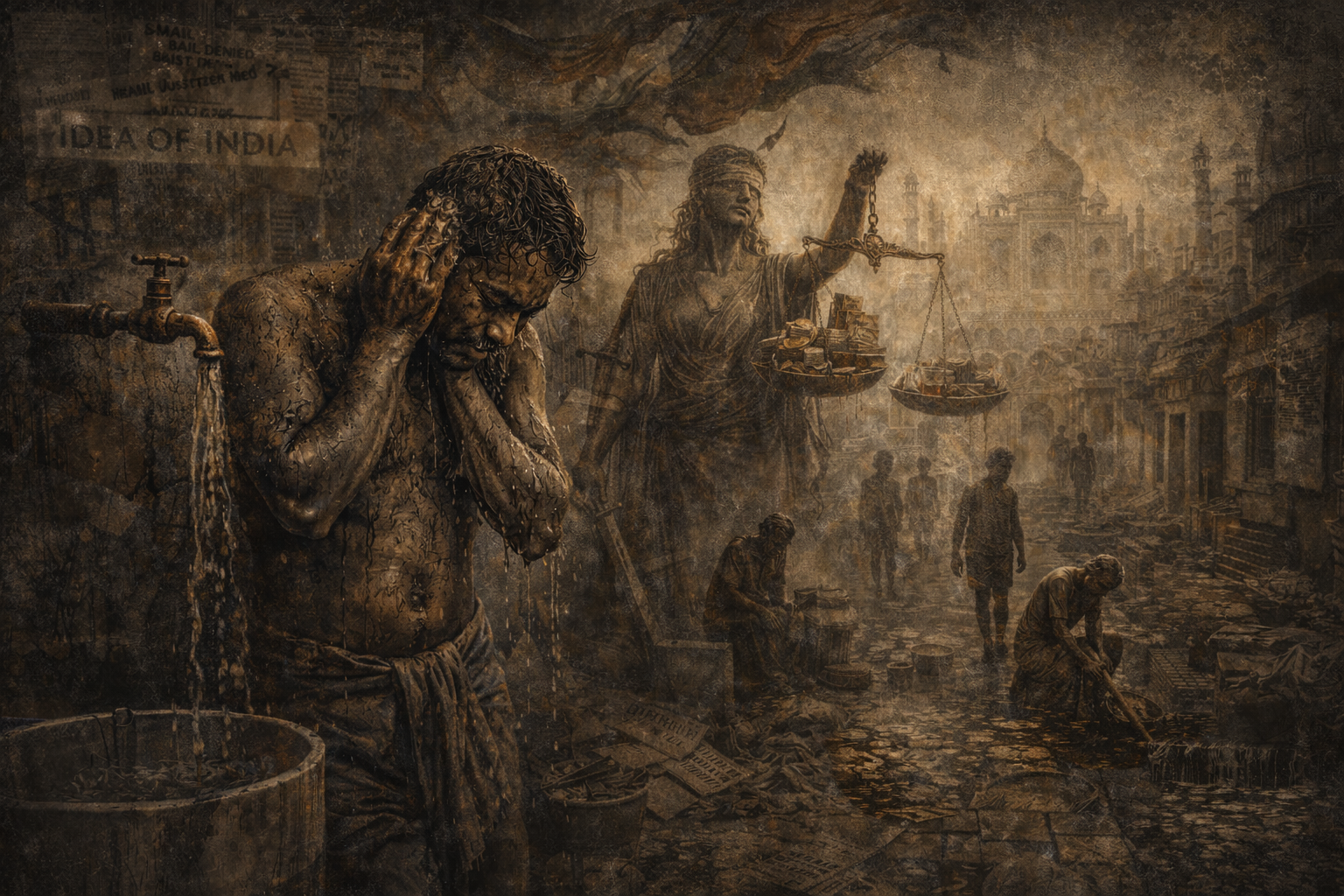
Executive Summary
India’s sanitation regime is not an unfortunate accident at the edge of an otherwise modern republic. It is one of the clearest places where caste remains materially alive. The persistence of manual scavenging and hazardous sewer and septic-tank cleaning shows that India has not abolished the social logic of untouchability. It has bureaucratized it, renamed it, outsourced it, and occasionally condemned it in court. But it has not abolished it.
This is not a hidden truth available only to activists or radical critics. The state’s own record has long made the structure visible. Government-origin figures cited in public reporting have shown that among identified manual scavengers for whom caste data were available, 97.25% were Scheduled Castes. The Supreme Court, in Safai Karamchari Andolan v. Union of India, also recognized the deep link between manual scavenging, caste hierarchy, and untouchability, and noted that more than 95% of identified manual scavengers were Dalits.
That fact changes the argument completely. If nearly the entire population compelled into this degrading work comes from historically oppressed castes, then sewer deaths cannot be described merely as labour-safety failures. They are the lethal edge of a caste order that has adapted to democracy without surrendering its hierarchy.
This Is Not a Hygiene Problem. It Is a Hierarchy Problem.
Indian public discourse repeatedly tries to sanitize the sanitation question. Governments prefer the language of "cleanliness drives," "urban management," "waste systems," "worker safety," and "rehabilitation." These terms are not entirely false, but they are politically convenient because they hide the central truth: the problem is not just filth. The problem is that Indian society has historically decided who must live closest to filth.
That distinction matters.
- A labour-safety problem can be solved with equipment, training, insurance, and compliance.
- A caste problem asks why the same communities remain available for degrading labour in the first place.
- A hygiene problem concerns waste disposal.
- A hierarchy problem concerns whose body is still treated as socially disposable.
Once the question is asked honestly, the evasions become harder to sustain. If the work were simply about public health, its burden would not fall so overwhelmingly on the same communities generation after generation. The concentration is too stark, too patterned, and too historically legible. India did not stumble into this arrangement by coincidence. It inherited it from caste society and has refused to dismantle it at the level that matters most: everyday social power.
The Constitution Says One Thing. The Sewer Says Another.
Article 17 of the Constitution abolished untouchability. That is one of the proudest claims of the Indian constitutional order. But the sewer remains a standing rebuttal to constitutional self-congratulation.
The contradiction is brutal:
- the Constitution says no human being should be degraded by caste,
- Parliament criminalizes manual scavenging,
- courts speak the language of dignity,
- governments announce rehabilitation schemes,
- and yet people still descend into toxic pits and die cleaning the waste of others.
This is why the sanitation question is not merely administrative. It is constitutional in the deepest sense. It reveals the distance between constitutional morality and social reality. India did not merely fail to implement a policy. It failed to uproot a civilizational arrangement that assigns pollution downward and innocence upward.
The sewer is therefore not just a site of municipal negligence. It is the place where the Constitution meets caste society and is made to look weak.
The State Performs Abolition While Administering Persistence
One of the ugliest features of the system is the state’s double performance.
On paper, India condemns manual scavenging. In practice, it keeps recording deaths from hazardous cleaning.
On paper, the state speaks of dignity. In practice, it tolerates contractor chains so elaborate that accountability evaporates the moment a worker dies.
On paper, compensation exists. In practice, families often face delay, dispute, bureaucratic cruelty, or partial recognition before the state admits that a death even falls within the category that triggers legal responsibility.
This is not merely incompetence. It is political convenience. A system of fragmented responsibility allows governments to claim moral opposition to manual scavenging while preserving the cheap labour arrangements that make municipalities function. The law announces abolition; the administrative machine quietly manages continuity.
That is why the phrase "implementation gap" is too soft. This is not a neutral gap between a good law and a clumsy bureaucracy. It is a structure in which the appearance of reform coexists with the reproduction of humiliation.
Outsourcing Is Not Reform. It Is an Alibi.
Municipal outsourcing is often presented as modern efficiency. In reality, it frequently functions as a moral laundering device.
When sanitation work is pushed through contractors and sub-contractors:
- the state keeps the service,
- the city keeps the cleanliness,
- the political class keeps plausible deniability,
- and the worker keeps the risk.
This is not an incidental design flaw. It is precisely how the system protects itself. A dead worker can be translated into paperwork: who hired him, who authorized entry, whether it was "official duty," whether the death fits a compensable category, whether equipment was "provided," whether the worker was "trained," whether he was "directly employed." Every level of fragmentation dilutes moral shock into procedural noise.
So long as responsibility can dissolve into contract language, caste can continue to operate through the back door of administration.
A Republic of Dignity Cannot Be Built on Disposable Bodies
The most repulsive feature of the current order is its moral asymmetry. The comfort of one section of society still rests on the bodily exposure of another. Waste must go somewhere. The question caste society has always answered is: into whose life?
That is why the continued language of "service" around these occupations is often obscene. A society that repeatedly sends some of its citizens into toxic spaces so others may preserve their comfort is not honoring service. It is rationalizing sacrifice.
And the sacrifice is not abstract.
- workers enter sewers and septic tanks without meaningful safety,
- families absorb death as routine social risk,
- widows and children are left to litigate recognition,
- and the public is invited to react with momentary pity rather than structural anger.
Pity is politically useful because it does not threaten the arrangement. It allows people to feel sad without asking what kind of society keeps producing the same victims.
Why Caste Is Visible at the Bottom and Hidden at the Top
One of the most revealing features of modern India is not just where caste is visible, but where it disappears.
At the bottom of the hierarchy, caste is hyper-legible. The state can identify sanitation workers, manual scavengers, sewer deaths, rehabilitation beneficiaries, and the over-representation of Scheduled Castes in degrading labour. Caste is documented where it stigmatizes.
At the top, caste becomes strangely blurred. Elite institutions often prefer the fiction of neutrality. Your source material makes this asymmetry clear in one especially telling way: the government has said it does not maintain caste-wise data for judges in the higher judiciary even while caste remains legible in low-status labour categories.
This asymmetry is not harmless. It allows caste to be narrated as a pathology of the oppressed rather than a structure of power. It documents caste where it marks shame, and obscures caste where it would raise uncomfortable questions about privilege, access, and institutional inheritance.
That is how modern caste protects itself: by being visible where it humiliates and invisible where it rules.
Manual Scavenging Survives Because Society Still Tolerates It
There is a sentimental liberal story that says manual scavenging is a leftover, a regrettable residue of tradition that the republic is slowly overcoming. That story is politically convenient and morally false.
Manual scavenging and hazardous sanitation labour survive because they are actively tolerated by the social order that claims to oppose them.
They survive because:
- households and institutions still demand someone else’s body to absorb the dirt they do not wish to confront,
- municipalities still rely on disposable labour where mechanization should have become non-negotiable,
- enforcement remains weak when the victims are socially marginal,
- and caste continues to shape who is treated as available for degrading work.
What survives for decades under legal prohibition is not an accident. It is a maintained arrangement.
The Language of Reform Is Often Too Polite for the Crime
India has generated a whole moral vocabulary for speaking about this issue without fully confronting it.
Words like:
- rehabilitation,
- inclusion,
- safety ecosystem,
- modernization,
- skilling,
- dignity of labour,
- and social justice
are all deployed in official speech. Some are necessary. Some are sincere. But together they can also function as a rhetorical shield against saying the harder thing plainly: a caste society still needs degraded labour, and it still finds it among those it has historically degraded.
Even the phrase "dignity of labour" can become evasive here. There is dignity in labour freely chosen and adequately protected. There is no dignity in a caste-shaped economy that assigns dangerous, stigmatized, and humiliating work to the same communities because the rest of society refuses proximity to its own waste.
The problem is not that sanitation work lacks dignity because dirt is shameful. The problem is that Indian society has never distributed the dirt equally.
The Politics of Civilizational Pride
This is where the question becomes especially uncomfortable for nationalist self-image.
A political culture that speaks incessantly of civilization, heritage, and cultural greatness ought to be judged by how it treats the people forced to clean its waste. If a country cannot prevent the routine degradation and death of those at the bottom of its caste order, then its civilizational rhetoric rings hollow.
This is not an argument against India. It is an argument against self-flattery.
A nation does not become honorable because it praises itself in grand language. It becomes honorable when the people historically treated as impure are no longer condemned to impure labour, no longer made invisible except at the moment of death, and no longer asked to carry the burden of everyone else’s moral evasion.
Public pride that coexists with caste-shaped degradation is not patriotism in its highest form. It is vanity protected by selective blindness.
What Elite India Still Refuses to Admit
Elite India often prefers a story in which caste is declining, urbanization is diluting old prejudices, and the republic is steadily moving toward merit, efficiency, and modern citizenship. The sanitation regime exposes the limits of that story with ruthless clarity.
If caste were really a fading residue:
- degrading labour would not remain so sharply caste-marked,
- abolition would not repeatedly fail in the same direction,
- sewer deaths would not be so socially predictable,
- and the victims would not be so easy to mourn without anyone having to give them real political power.
The truth is uglier. Caste has not disappeared into modernity. It has modernized. It now moves through municipal contracts, bureaucratic delay, technocratic language, selective data collection, and managed public sympathy. The hierarchy is older than the republic, but the republic has learned how to coexist with it.
That is why reform without confrontation is not enough. Mechanization matters. Compensation matters. Rehabilitation matters. But if the underlying caste logic remains intact, the system will simply reorganize itself and produce the same victims under a cleaner administrative vocabulary.
What a Serious Politics Would Require
If India were serious about abolition rather than performance, it would treat this issue not as a welfare question but as a structural emergency.
A serious politics would require at least four things.
- Total non-negotiable mechanization of sewer and septic-tank cleaning wherever technologically possible, with criminal consequences for unlawful human entry.
- Direct accountability of public authorities, not just contractors, whenever a worker dies in hazardous cleaning.
- Material rehabilitation that actually changes life chances, not token schemes that leave caste-bound labour markets intact.
- A public moral shift in which manual scavenging is understood not as unfortunate work done by unfortunate people, but as a continuing social crime.
Without that moral shift, reform remains managerial rather than transformative.
The Real Indictment
The strongest conclusion is also the simplest. India remains a deeply caste-struck society, and its sanitation regime is one of the clearest proofs.
The pattern is unmistakable:
- overwhelming Dalit concentration in manual scavenging,
- recurring deaths in sewers and septic tanks,
- chronic absence of meaningful protection,
- judicial recognition that the practice is rooted in untouchability,
- and a public order in which degrading labour persists despite decades of formal prohibition.
That pattern does not describe a society that has moved beyond caste and is merely waiting for better implementation. It describes a hierarchy that has survived constitutional embarrassment and adapted to modern administration.
The final obscenity is not only that people die cleaning sewers. It is that the republic has learned to treat those deaths as routine enough to survive them politically.
That is why this issue should not be written about in the soft language of residue, tragedy, and gradual reform. It should be named for what it is: a standing accusation against a society that celebrates dignity in principle while rationing it in practice.
India’s sanitation regime is not an exception to caste. It is one of caste’s most truthful institutions.