Executive Summary
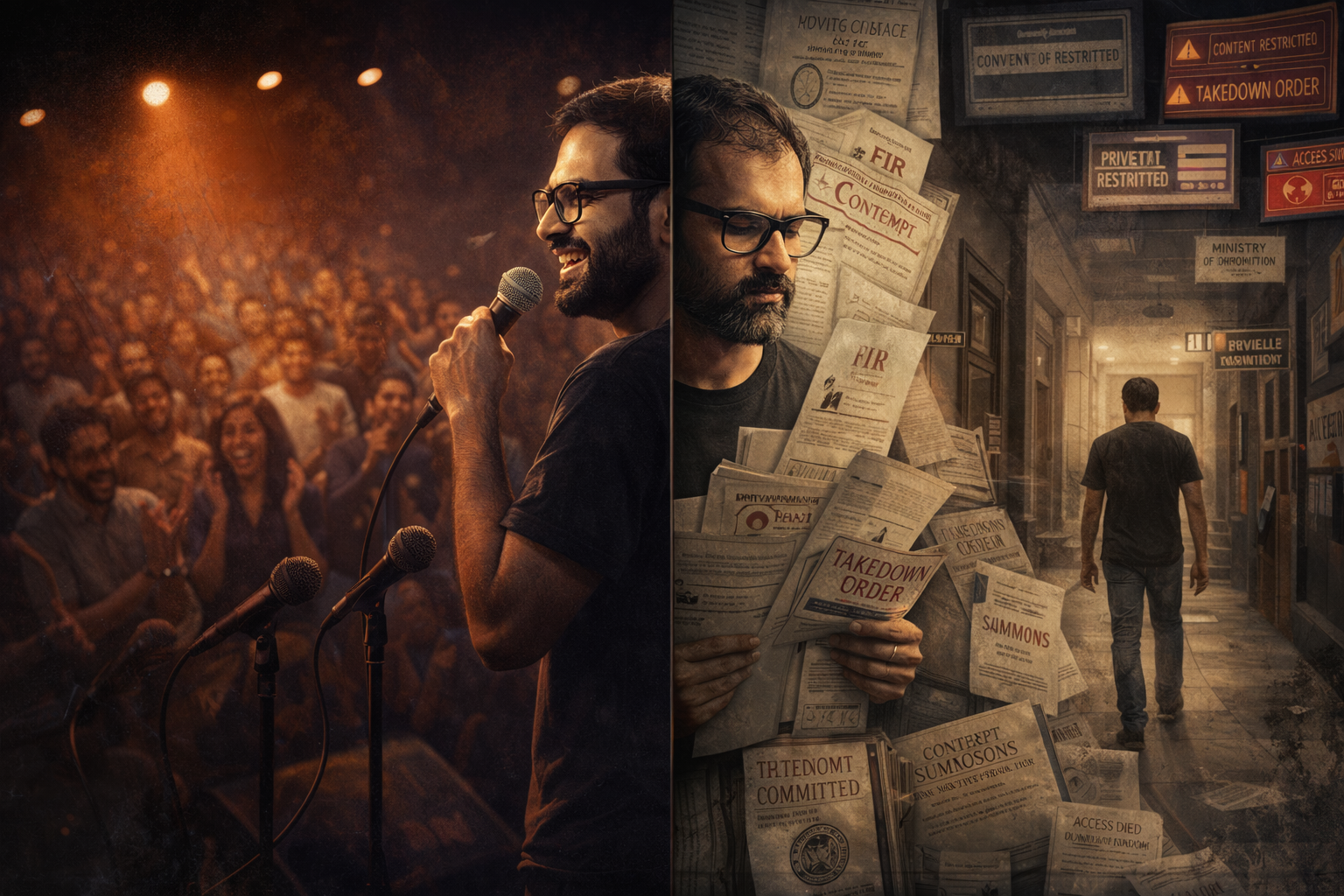
Kunal Kamra’s public career is not just the story of a comedian who became political. It is also the story of how the Indian system increasingly handles dissent when that dissent becomes too visible, too viral, or too embarrassing to ignore.
His trajectory shows a clear shift:
- first, pressure through threats, harassment, and venue problems,
- then pressure through airline bans, regulatory procedures, and public condemnation by ministers,
- then contempt petitions in the Supreme Court,
- then speech-related FIRs and legislative privilege proceedings,
- and finally battles over the architecture of digital speech regulation itself.
That shift matters. It suggests that the Indian state and adjacent institutions have become more sophisticated in how they manage political speech. They do not always need blunt censorship. They can use a whole ecosystem of deterrence:
- police process,
- administrative rules,
- litigation burden,
- platform governance,
- legislative privilege,
- and long-pending legal exposure.
The strongest defensible claim is not that India has abolished democracy. The stronger claim is more precise and, for that reason, more disturbing: the space for dissent remains formally open but is being made costlier, riskier, slower, and more exhausting to occupy.
Kamra’s legal history is therefore important not merely because he is famous, provocative, or polarizing. It is important because his cases reveal how a modern democratic state can narrow free expression without always needing an outright ban.
Why Kunal Kamra Matters Beyond Comedy
It is easy to dismiss Kamra as "just a comedian." That is exactly why the record around him matters so much.
States do not usually reveal their real tolerance for dissent when facing armed rebellion or formal opposition parties alone. They reveal it in how they treat public ridicule. Satire is politically dangerous because it strips power of dignity. It takes prestige and turns it into material for laughter. And insecure political systems hate being laughed at.
That is why Kamra’s career became a useful barometer. He was not leading a political party. He was not commanding a mass movement. He was using speech, mockery, live performance, and digital circulation. Yet even that was enough to trigger:
- repeated intimidation,
- formal legal proceedings,
- state-linked restriction,
- and extraordinary sensitivity from institutions that normally present themselves as secure and above satire.
A strong democracy can absorb insult. A brittle one treats mockery as subversion.
How He Came Into the Limelight
Kamra’s early visibility came from stand-up, digital circulation, and a style that blended observational comedy with increasingly explicit political satire. By 2016, he was already gaining mainstream attention as a stand-up comic with a recognizable voice and a willingness to test boundaries.
A major turning point came with the viral spread of his early political material, especially the 2017 routine often cited under the title "Patriotism & the Government." That work did not merely joke about politicians. It mocked the emotional and moral language that had begun to dominate Indian political life:
- hyper-nationalism,
- loyalty theater,
- outrage culture,
- and the demand that citizens perform patriotism while ignoring failures of governance.
That was a key escalation point. Once the satire moved from personal irritation and social absurdity into nationalism, state culture, and media power, the reaction intensified. Major reporting from the period documented online threats and harassment. That was the early warning sign.
Before the state uses formal power, society often tests the ground through intimidation first.
The First Layer of Coercion Was Informal
One of the mistakes people make when talking about censorship is that they look only for jail, bans, or explicit criminal orders. But political coercion usually begins much earlier and in softer forms.
In Kamra’s case, the early pattern included:
- online abuse,
- threats after viral political material,
- pressure on venues,
- and even reported housing fallout linked to his politics-facing comedy.
These are not trivial side stories. They matter because they show how speech can be punished before the law even enters the room.
This is how democratic pressure often works in practice:
- formal rights remain on paper,
- but the social cost of using them rises,
- and public institutions can then step in later against a weakened and already marked target.
That makes the distinction between "state censorship" and "social backlash" less neat than people imagine. In politically charged environments, informal intimidation often prepares the ground for formal coercion.
The 2020 Airline Episode Was a Turning Point
The in-flight confrontation with Arnab Goswami in January 2020 marked a major transition in Kamra’s public and legal trajectory.
Once he posted the video of the confrontation aboard an IndiGo flight, the response escalated very fast:
- airlines imposed bans,
- the civil aviation ministry became publicly involved,
- regulatory frameworks were invoked,
- and the matter entered the Delhi High Court and DGCA process.
That matters because this was no longer just about social backlash. It became a case study in how quickly private actors and state-signaling can combine to restrict a dissenter’s mobility.
The due-process concern here was obvious. The DGCA’s framework for unruly passengers sets procedures, committees, and penalty bands. But in real time, the political mood around the incident risked overtaking the rulebook. Once the minister publicly urged restrictions and multiple carriers moved in step, the distinction between private business choice and politically encouraged punishment became much thinner.
A procedural route still existed, and the courts did not simply endorse everything. But the broader message was unmistakable: public humiliation of a politically influential media figure could trigger swift consequences across institutions.
That is what made the episode bigger than a stunt. It showed how speech-adjacent conduct could activate a network of administrative restriction far beyond the original incident itself.
The Supreme Court Contempt Cases Expose a Deeper Fragility
If the airline episode showed how executive and regulatory structures can close in, the contempt petitions revealed something even more uncomfortable: the judiciary itself can become a site of speech anxiety.
In December 2020, the Supreme Court issued notice in multiple criminal contempt petitions over Kamra’s tweets about the judiciary. Attorney General consent was part of the process, and the matter entered the Court formally. Kamra later filed a widely discussed affidavit defending satire, criticism, and the democratic necessity of irreverence toward institutions.
The central problem here is not subtle.
When a comedian can face criminal contempt exposure for mockery of the judiciary, the constitutional message becomes chilling very quickly. Even if no conviction follows, long pendency itself can punish:
- it keeps uncertainty alive,
- it forces continued legal defense,
- it signals risk to others,
- and it teaches artists that some subjects carry indefinite institutional cost.
That is why pendency matters so much. A speech case does not have to end in prison to produce fear. Sometimes the process is the deterrent.
In Kamra’s case, the fact that these contempt matters were still appearing on Supreme Court cause lists into 2026 tells its own story. The issue is not only whether the Court eventually punishes. The issue is that it can keep the threat hovering.
When the State Cannot Silence Speech Directly, It Regulates the Infrastructure Around It
One of the most important dimensions of Kamra’s legal career is that it moved beyond individual speech incidents and into the architecture of online regulation itself.
His challenge to the Centre’s "fact-check unit" framework became one of the most consequential digital-speech cases in India. This was not a narrow personality-driven dispute. It raised a much larger constitutional question:
Can the government build a mechanism through which the State effectively gets to certify what counts as false information about its own business?
That is a dangerous proposition in any democracy. In a polarized democracy, it is worse.
The reason is simple. A government that is already powerful in lawmaking, policing, prosecution, and administration should not also become the official referee of truth in disputes about itself. Once that happens, criticism can be transformed into "misinformation" by a process designed by the very authority under scrutiny.
That is why the litigation mattered so much. And it is also why the judicial response in that line of cases is one of the strongest counterexamples to any lazy claim that all courts are simply aligned with the state. The Supreme Court stayed the FCU notification. The Bombay High Court later struck down the amended rule. The speech-protective significance of that cannot be denied.
But the broader political lesson remains sharp: the fact that such a rule was attempted at all tells you something serious about the direction of the system.
The System Around Speech Is Getting More Aggressive
Kamra’s later cases show that this is no longer about one platform, one joke, or one controversy. It is about a widening environment of legal pressure.
By 2025-26, the pattern included:
- FIRs tied to alleged remarks about Eknath Shinde,
- anticipatory-bail litigation across states,
- Bombay High Court protection from arrest while a quashing petition remained pending,
- privilege proceedings in the Maharashtra Legislative Council,
- and fresh litigation challenging newer IT-rule and platform-governance structures such as the Sahyog Portal framework.
At that point, the issue is no longer whether Kamra is controversial. Of course he is. The deeper issue is institutional stacking.
Once a dissenter is forced to fight across:
- police process,
- criminal courts,
- constitutional courts,
- administrative systems,
- and legislative privilege bodies,
the burden becomes the punishment.
That is what modern speech control often looks like. It does not always need one dramatic ban. It can wear you down through multiplicity.
Five Stages of Escalation
The pattern becomes easier to understand when broken into stages. The sequence below shows how pressure moved from informal backlash to a broader, multi-forum legal burden.
| Stage | Period | What Happened | Why It Matters |
|---|---|---|---|
| Emergence and informal intimidation | 2016-2018 | Mainstream stand-up visibility, viral political comedy, threats after political videos, and reported housing pressure linked to his politics-facing work. | This was the early warning phase. Speech was not yet buried under major legal machinery, but the cost of political comedy was already rising through intimidation and social pressure. |
| Regulatory and executive escalation | 2020 | The in-flight confrontation led to airline bans, DGCA process, Delhi High Court proceedings, and public ministerial pressure around mobility restrictions. | The issue moved beyond backlash and into executive-regulatory space. Mobility itself became vulnerable to a mix of political signaling and formal procedure. |
| Institutional retaliation through speech law | 2020 onward | Supreme Court contempt proceedings over tweets about the judiciary remained pending for years, creating prolonged legal uncertainty around satire and institutional criticism. | This showed that speech risk was no longer coming only from governments or mobs. Institutions that claim constitutional authority could also become part of the chilling structure. |
| Constitutional resistance | 2023-2026 | Kamra became a petitioner in major constitutional speech litigation, challenging the FCU framework and later newer content-control structures. Courts delivered important speech-protective orders in parts of this battle. | This is the counterpoint. The judiciary was not uniformly aligned with the state; some of the strongest speech-protective interventions in his record came from courts. |
| Multi-forum coercion | 2025-2026 | Speech-linked FIRs, interstate bail proceedings, Bombay High Court anti-arrest protection, privilege proceedings, and fresh digital-regulation litigation all converged into a heavier system of pressure. | At this point, the burden itself became part of the punishment. The issue was no longer one controversy, but the need to survive several legal and institutional arenas at once. |
Incident Map: How the Pressure Changed
| Phase | Typical Pressure | What It Shows |
|---|---|---|
| Early public controversy | Threats, harassment, venue and housing pressure | The first cost of dissent is often social, not judicial |
| Executive-regulatory pressure | Airline bans, ministry signaling, DGCA process | Private restrictions can harden quickly when the political atmosphere invites them |
| Institutional speech exposure | Criminal contempt proceedings and long pendency | Courts can become part of the chilling structure, even without final punishment |
| Constitutional pushback | Challenges to FCU and digital-speech controls | The judiciary is not uniformly deferential; some speech-protective intervention still exists |
| Multi-forum burden | FIRs, bail, quashing, privilege proceedings, IT-rule challenges | The burden of fighting in many arenas can itself become a mode of punishment |
The Judiciary’s Role Is Not Simple, and That Makes It More Important
It would be too easy, and not fully accurate, to say the judiciary is simply "with the state" in every Kamra matter.
That is not what the record shows.
The speech-protective interventions in the FCU litigation are real and significant. The Bombay High Court’s final judgment striking down the amended rule mattered. The Supreme Court’s stay of the notification mattered. The Bombay High Court’s protective order against arrest in the Shinde-linked FIR also mattered.
Those are not small details. They are major legal events.
But that does not mean all is well. Courts can still contribute to a chilling environment in other ways:
- by allowing long pendency in speech-sensitive matters,
- by keeping contempt exposure alive for years,
- by moving cautiously when speed itself is a civil-liberties question,
- or by forcing dissidents through elaborate procedural routes before giving relief.
So the most accurate conclusion is not that the judiciary is uniformly captured. It is that judicial behavior is internally mixed in a way that still leaves dissidents vulnerable. Some benches protect speech. Other judicial tools, including contempt and delay, can still amplify fear.
That is institutionally more complicated than open alignment, but it is not reassuring.
What the Kamra Record Suggests About the Indian State
The clearest pattern is escalation by formalization.
At first, political satire attracts threats. Then it attracts ministerial condemnation. Then it attracts regulatory action. Then it attracts criminal and quasi-criminal proceedings. Then it collides with the machinery for governing digital truth itself.
This is not random.
It suggests that the Indian state, together with adjacent institutions of influence, has become increasingly willing to treat uncomfortable speech as something to be managed across systems rather than answered in politics.
That is the deeper controversy here. The issue is not whether Kamra is provocative. Of course he is. Satire is supposed to provoke. The issue is whether the state and its surrounding institutions are becoming too willing to turn provocation into process.
And once speech is buried inside enough process:
- the artist becomes a litigant,
- the joke becomes a record,
- the public argument becomes a case file,
- and the burden of defense becomes part of the penalty.
Why This Should Worry Anyone Who Cares About Democracy
The danger is not only to comedians. The danger is to democratic culture itself.
If satirists learn that the price of mockery can include:
- years of contempt exposure,
- FIRs in multiple jurisdictions,
- venue cancellations,
- legislative privilege pressure,
- and endless legal navigation,
then public speech narrows even before formal censorship arrives.
That is how fear works in a formally democratic order. It does not always need a ban. It only needs enough examples to teach everyone else what the price might be.
Kamra’s importance lies here. His record makes visible a broader transformation in India’s public sphere. Expression is still possible. Criticism is still possible. Satire is still possible. But the cost of doing it against the wrong targets appears to be rising.
And when the cost of dissent rises unevenly, democracy remains alive in form but becomes thinner in substance.
A More Honest Conclusion
Kunal Kamra’s public career should not be read merely as a chain of controversies around an abrasive comic. That framing is too small and too convenient.
His career is better understood as a legal and political map of how dissent is managed in contemporary India.
The map shows:
- informal intimidation,
- executive signaling,
- regulatory punishment,
- judicial exposure,
- constitutional resistance,
- and multi-forum legal fatigue.
The state does not need to jail every dissenter to narrow democratic space. It only needs to make a few people carry enough visible burden that others learn the lesson in advance.
That is what makes the Kamra record so important. It shows a republic in which free speech is still praised in principle, but where satire against powerful institutions can trigger an expanding ring of consequences.
That should not be shrugged off as the normal cost of controversy. It should be recognized for what it is: evidence that the Indian system is becoming increasingly sophisticated in how it pressures dissent while continuing to speak the language of democracy.