Executive Summary
The Sonam Wangchuk matter is often flattened into one headline about one arrest. Legally and politically, that is misleading. It was really two different state actions, and together they tell a much darker story about modern India.
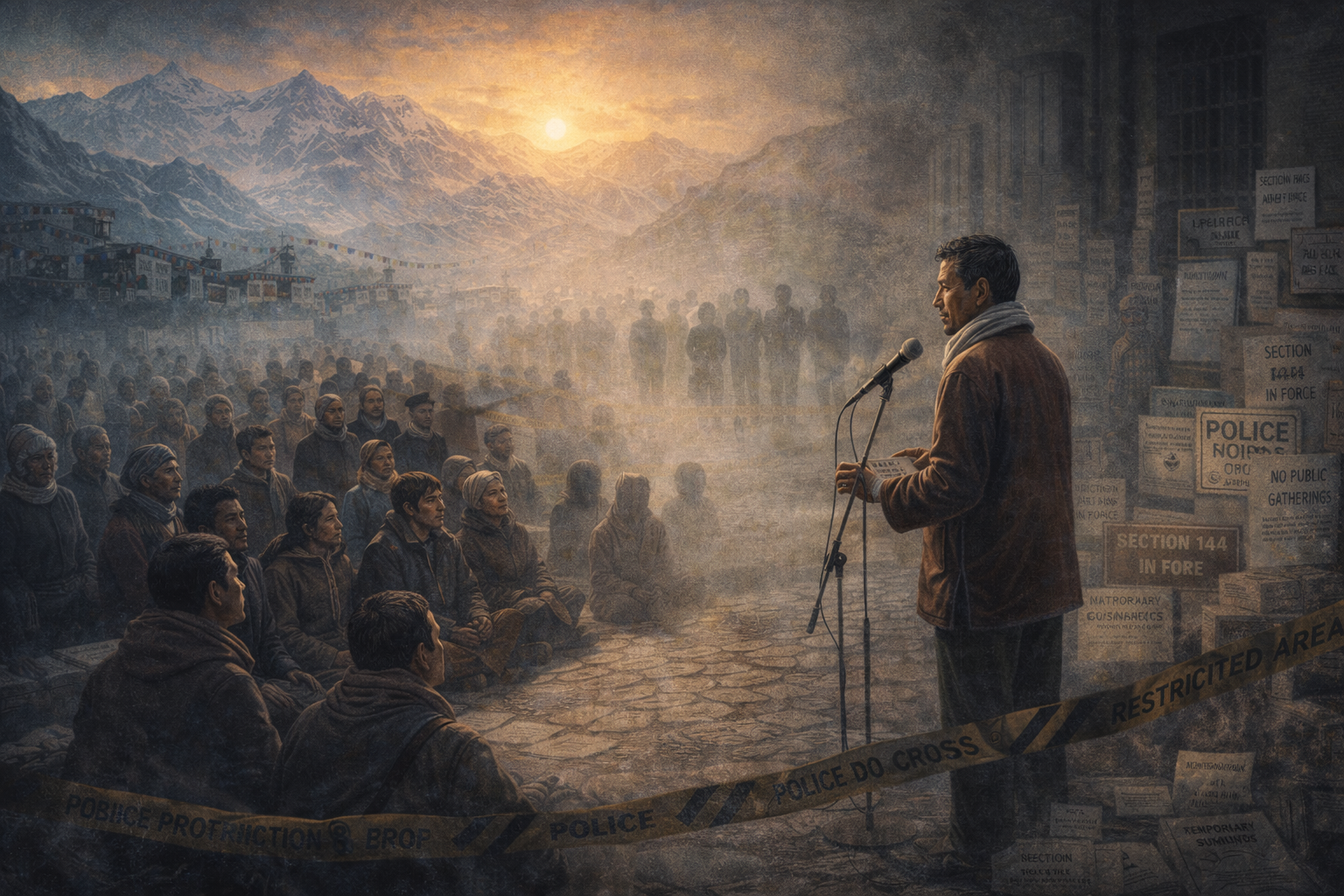
The first came in September-October 2024, when Delhi Police detained Wangchuk and around 125 Ladakhi marchers at the Singhu border while they were trying to walk peacefully toward Rajghat. The second came in September 2025, when, after violent unrest in Leh in which four people died in police firing, Wangchuk was detained under the National Security Act, one of India’s harshest preventive-detention laws.
That distinction matters because the first episode was about policing protest, while the second was about locking a dissenter inside the logic of national security.
Read together, the two episodes reveal something more serious than a dispute between one activist and one government. They show how the Indian state increasingly handles dissent in stages:
- first as a problem of crowd control,
- then as a problem of public order,
- and finally, if needed, as a problem of security.
That sequence should disturb anyone who still wants to believe that constitutional dissent remains safe in Indian public life.
This Was Never Just About One Activist
The deeper political background was Ladakh’s unresolved status after 2019. Wangchuk’s campaign focused on ecology, glaciers, local autonomy, and the fear that Ladakh would be politically and administratively reordered without meaningful protection for its people. The broader movement raised demands tied to:
- statehood,
- Sixth Schedule protections,
- local recruitment safeguards,
- and political representation.
Those were not fringe demands. They were constitutional and political demands emerging from a region that felt structurally unheard.
And that is precisely why the case matters beyond Wangchuk himself. A democracy should be able to absorb such demands through politics. But when politics fails, the state often reaches for administration. And when administration is not enough, it reaches for force.
That is the pattern here.
The 2024 Delhi Detentions Showed a State Afraid of Peaceful Dissent
The 2024 Delhi episode already contained the core problem in miniature.
Wangchuk and Ladakhi marchers were not approaching the capital with weapons. They were walking toward Rajghat, a site loaded with Gandhian symbolism. That should have forced the state into constitutional embarrassment. Instead, the police treated the march as a manageable law-and-order inconvenience.
The Delhi Police Commissioner issued an order under Section 163 of the Bharatiya Nagarik Suraksha Sanhita. The order banned assemblies of more than five people, dharnas, and placards near Delhi’s borders and in parts of central Delhi. The justifications cited included:
- the communal atmosphere,
- MCD Standing Committee elections,
- Assembly elections in Jammu and Kashmir and Haryana,
- and expected VVIP movement around Gandhi Jayanti.
This is where the legal language begins to reveal its political function.
Section 163 gives the administration real preventive power. But real power is not the same thing as legitimate use. The constitutional question is not whether the state can regulate protest at all. Of course it can. The question is whether the restriction is narrow, necessary, and proportionate, or whether it is so wide that public-order language becomes a polite way of saying: this protest is inconvenient, so it must disappear.
That is what troubled the 2024 episode. The state did not defeat Wangchuk in public argument. It did not out-reason him. It did not negotiate transparently. It blocked the march, detained the protesters, and then later softened its position once the matter reached the Delhi High Court and the pressure shifted.
That is not how a confident democracy behaves. That is how a nervous one buys time.
The Legal Form Was Procedural. The Political Message Was Clear.
Defenders of the state can always fall back on formal legality. They can say:
- the order was issued under law,
- the police acted within prohibitory restrictions,
- the order was temporary,
- the detainees were later released,
- and the government eventually withdrew the order.
All of that may be formally true. But formal truth can still conceal political bad faith.
The real message sent in 2024 was simple: even a peaceful constitutional march tied to environmental protection and political safeguards could be treated as a public-order risk before it was treated as a democratic claim.
That reversal matters. In a healthy democracy, protest is presumptively political first and police-managed second. In a brittle democracy, protest becomes a policing problem first and a constitutional issue only after courts are forced to notice.
The Wangchuk march exposed that brittleness.
The 2025 NSA Detention Was a Much More Serious Escalation
If the 2024 episode was troubling, the 2025 episode was far worse.
After violent protests in Leh left four people dead and public property was damaged, Wangchuk was detained under the National Security Act. That changed the legal terrain entirely. This was no longer about a temporary order managing a protest route. This was the state invoking preventive detention.
That move matters because preventive detention is among the most dangerous powers Indian law still preserves. It allows the executive to imprison a person not on the basis of a completed criminal conviction, but on the claim that detention is needed to prevent future acts prejudicial to public order or the security of the state.
In plain language, it allows the state to say:
we do not need to prove fully what you did; it is enough that we say we fear what you may do.
That power always arrives dressed in the language of necessity. The area is sensitive. The mood is volatile. The officer on the ground knows best. The law is preventive, not punitive. The risk is too serious to wait.
That is precisely what makes it dangerous. Preventive detention is where executive fear is given legal clothing and called constitutional order.
The NSA Is a Tool of Control, Not Ordinary Justice
The National Security Act is not an ordinary criminal law. Under Section 3, the government can detain a person to prevent acts considered prejudicial to the security of the state or the maintenance of public order. Section 8 requires communication of grounds within a short window. Section 13 permits detention for up to twelve months.
The constitutional doorway for all of this is Article 22, which protects ordinary arrest safeguards but also preserves a special space for preventive detention.
That exception has always been one of the ugliest compromises in Indian constitutionalism.
The basic problem is obvious. A criminal trial, in principle, asks what happened and whether the state can prove it. Preventive detention asks what the executive fears might happen and how much deference courts are willing to show toward that fear.
Once the state shifts the case into that preventive frame, liberty becomes far easier to suppress and far harder to defend.
This is why the Wangchuk detention triggered such deep concern. The state was not simply prosecuting a public figure for a proven offense in open court. It was invoking a structure of law designed to move power away from ordinary trial and toward executive prediction.
The State’s Theory Was Broad Enough to Swallow Dissent
The government’s theory, as reported during the litigation, was expansive. It said Wangchuk’s speeches had to be read in the context of a sensitive border region adjoining China and Pakistan. It argued that the District Magistrate in such an area deserved latitude. It portrayed Wangchuk as someone whose statements could inflame a volatile environment, disturb the "tempo of life," and affect national interests.
That kind of argument is always politically powerful because it can absorb almost anything into a security vocabulary.
Once the state says:
- the border is sensitive,
- the atmosphere is charged,
- local unrest could spiral,
- national interests are at stake,
the ordinary democratic question starts to disappear. Speech is no longer heard first as political speech. It is heard as pre-security material waiting to be interpreted against the state’s fears.
This is where dissent becomes vulnerable. Not because the state openly says protest is illegal, but because it expands the category of danger until protest can be folded into it.
The Trouble With the Evidence Was Not a Side Issue
One of the most disturbing parts of the case was the challenge to the material used to justify detention.
Wangchuk’s side argued that the detention record was infected by:
- stale material,
- copy-paste reasoning,
- selectively clipped speeches,
- FIRs with weak or no proximate link,
- and material that either did not clearly implicate him or had been pulled out of context.
His wife also alleged that the videos relied upon to justify detention did not even show him. That claim, by itself, is not a final judicial finding. But it goes to the core of the issue. If liberty can be taken away on the basis of speeches, clips, and administrative satisfaction, then the evidence has to be current, complete, and fairly presented. Otherwise preventive detention becomes dangerously close to preventive storytelling.
And that is the rule-of-law problem in its rawest form: if the executive can jail a dissenter on a predictive theory of public order, but the material is thin, selective, or weak, what exactly remains of meaningful constitutional protection?
The Supreme Court Did Not Collapse. But It Did Not Finish the Job Either.
The Supreme Court phase is what makes this story especially unsettling.
The easy version of the argument would be to say the Court simply sided with the state. That is not quite accurate. The bench did show skepticism. It reportedly questioned the state’s reading of the speeches. At one point it suggested the government was making an "ant out of molehill." It also raised a serious procedural concern about whether Wangchuk had meaningfully seen the videos relied upon against him, rather than merely received a pen drive and an endorsement of documents.
Those are not trivial moments. They show the bench could see the cracks.
But seeing cracks is not the same thing as closing the door on abuse.
The hearings dragged. Adjournments accumulated. The government sought more time after transcript errors surfaced. Wangchuk’s side warned that the delay itself was sending a terrible signal. And then, before a final judicial determination on the legality of the detention, the Centre revoked the NSA order.
That move was politically elegant and constitutionally corrosive.
The state got months of detention. The Court got to avoid a clean ruling on the merits. And the core constitutional question dissolved.
Revocation Did Not Answer the Real Question
On March 14, 2026, the Centre revoked the detention, saying it wanted to promote peace, stability, mutual trust, and meaningful dialogue in Ladakh. It also noted that Wangchuk had already undergone nearly half the detention period.
Later, the Supreme Court disposed of the challenge after the revocation.
No court squarely held the detention illegal. No final constitutional standard was laid down. No clear doctrinal rebuke was delivered.
That means the executive was able to retreat before final defeat and still preserve the legal ambiguity that made the detention useful in the first place.
It is fair to infer that the state preferred withdrawal to the risk of a full judicial confrontation on a weak or troubling record. But that remains an inference, not a judicial conclusion.
Still, the practical effect is hard to miss. A citizen lost liberty for months under an extraordinary law. The Court raised doubts. The executive stepped back late. And the constitutional system ended without a decisive answer.
That is not how strong civil-liberties jurisprudence is built. That is how evasive states survive judicial weather.
This Is How Democratic Space Shrinks Without Formal Collapse
The most defensible and serious conclusion is not that Indian democracy has formally ended. That claim would be too broad. The stronger point is narrower and, for that reason, harder to dismiss.
Democracy weakens when the state begins to treat dissent first as a policing problem and only later, if forced, as a constitutional conversation.
That is what happened here:
- in 2024, a peaceful march was blocked under a sweeping order and the protesters were detained,
- in 2025, a movement leader was detained under the NSA in the name of security and public order,
- in 2026, the state revoked the detention before a final merits ruling, and the Court allowed the main constitutional issue to fade away.
None of these steps, taken alone, proves full democratic collapse. Taken together, however, they reveal a disturbing pattern: the state is increasingly willing to use exceptional legal tools against politically inconvenient dissent, while institutions of review move too cautiously to provide a clear and timely constitutional answer.
That is how public freedom narrows in a formally democratic system. Not always through dramatic declarations. Often through procedure, delay, executive vocabulary, and tactical retreat.
A Confident Democracy Does Not Need to Behave Like This
A confident democracy regulates protest carefully. It prosecutes crime transparently. It distinguishes sharply between violence and dissent. It does not casually move political agitation into the grammar of national security.
A nervous democracy behaves differently.
It reaches for:
- broad protest bans,
- public-order rhetoric,
- preventive detention,
- and judicial delay that quietly helps the executive.
The Wangchuk case matters because it shows how close modern India is drifting toward that second model. The danger is not only to one activist, one region, or one movement. The danger is to the wider democratic principle that dissent should remain visible, peaceful, and publicly protected rather than steadily converted into a problem for police, magistrates, and security law.
That is why this case should not be remembered as a minor procedural episode or a technical detention dispute. It should be remembered as a warning: the Indian state is becoming increasingly comfortable treating constitutional dissent as something to contain before it is something to hear.