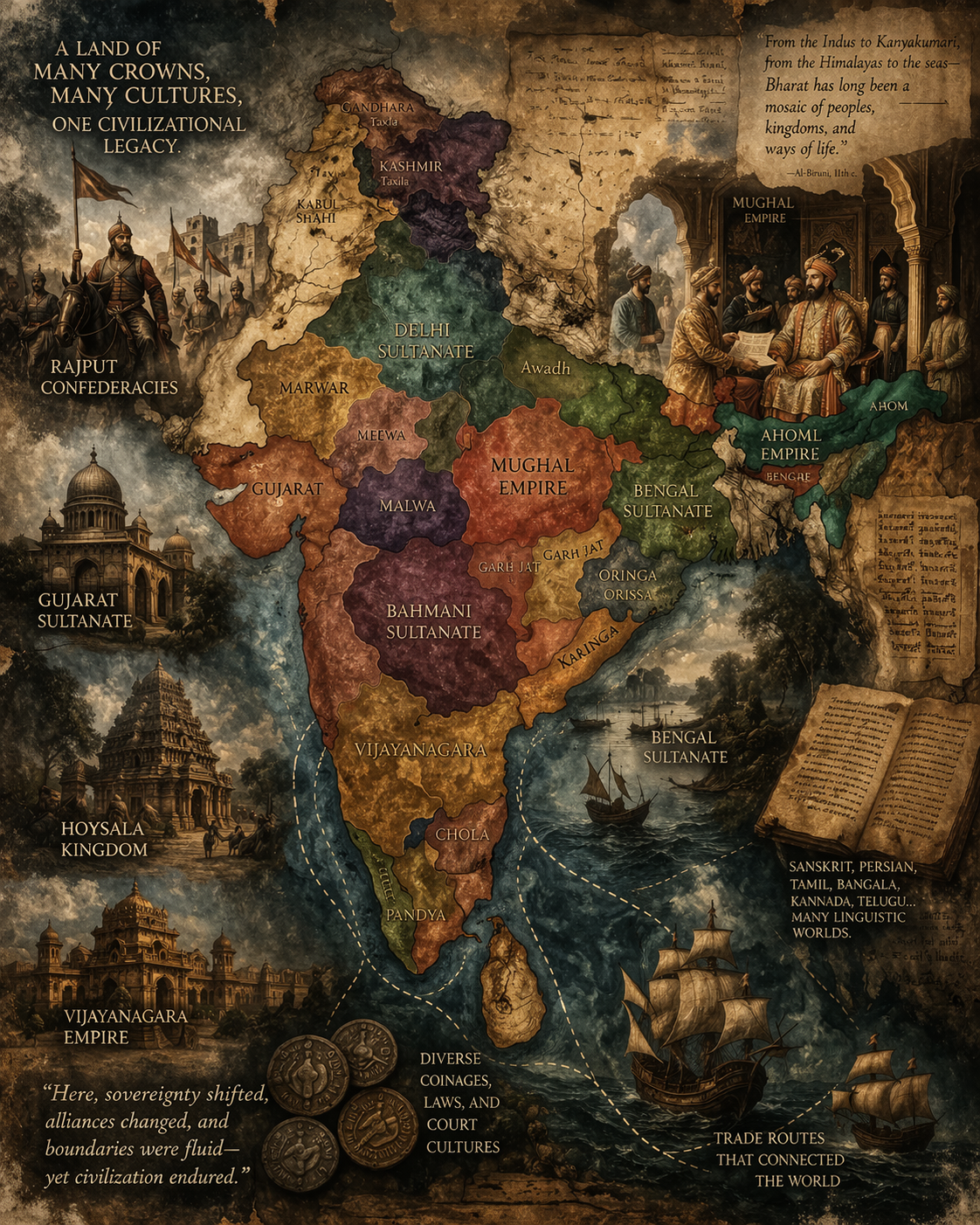
Core claim: For much of South Asian history, political order did not rest on one uniform state. It rested on layered sovereignty: a system in which emperors, courts, chiefs, estates, and armed intermediaries all exercised real governing power at the same time.
Executive Summary
This article examines the long-run political structure of the subcontinent through the lens of layered sovereignty. The central point is simple: South Asia was often governed through overlapping powers rather than a single, uniform state.
Even where an emperor, confederate leadership, or colonial paramount power stood at the top, practical control was distributed across many centers. Courts, chiefs, zamindars, jagirdars, feudatories, military households, and princely rulers all held meaningful authority over revenue, coercion, justice, and administration.
That pattern appears across several domains:
- cultural integration paired with administrative plurality,
- fiscal delegation rather than uniform bureaucracy,
- legal patchworks rather than a single jurisdiction,
- regional language regimes in governance,
- intermediate rights over land and extraction,
- and military obligations structured through negotiation, subsidy, and treaty.
The point is not that empires were unreal, or that centralization never happened. The point is that central rule often worked by accommodating, managing, and bargaining with semi-autonomous units rather than replacing them.
The colonial period made this unusually explicit. Treaties, sanads, gazetteers, and state manuals preserved the technical grammar of semi-autonomy: alliances, subsidies, controlled foreign relations, cantonments, assigned districts, jurisdictional cessions, succession rules, and regulated military forces.
The modern legal break came in 1947. The end of British paramountcy exposed how fragmented the political map still was immediately before independence: "India" included many polities whose internal government persisted even though their external relations had long been mediated through imperial power.
Scope and Framing
To keep the argument disciplined, this essay works with a few clear assumptions and limits.
Open assumptions and scope
- Political entities: "Princely states" is treated as a late-colonial category, but the argument reaches backward to structurally similar kingdoms, confederacies, estates, and fiscal-military jurisdictions.
- Period emphasis: The focus is mainly on the early-modern to late-colonial transition, roughly the 16th to mid-20th centuries, where administrative and treaty records are richest.
- Source priority: Primary and official materials matter most here, especially treaty collections, regulations, state manuals, gazetteers, and statutes. Scholarly work is used chiefly for conceptual framing.
- Source caution: Colonial compilations are technically useful but politically situated. Where possible, the argument relies on the structure of the documents and the powers they record.
- Audience level: The article is written for a general reader with some historical interest, not for a specialist historiography debate.
- Quantification: Where exact counts are unnecessary to the argument, the article prefers qualitative description over false precision.
The Core Argument
A major difficulty in describing pre-modern South Asia is that modern assumptions fit badly. Fixed borders, a monopoly over coercion, and uniformly administered law are poor default models for much of the region's history.
One useful vocabulary for this is the scholarship on the segmentary state. That approach distinguishes a single ritual or sovereign apex from the practical distribution of coercive and administrative power across many domains. In that view, political order can be real, durable, and extensive without being uniform.
That does not mean central authority was irrelevant. It means central authority often ruled through nested jurisdictions, delegated extraction, and negotiated obedience.
Open the six main lenses of plurality
Cultural and symbolic unity, administrative plurality: Shared idioms of kingship, dharma, imperial service, or sacred geography could coexist with highly uneven local government.
Fiscal delegation as statecraft: Power frequently scaled through assignments, offices, jagirs, and intermediary claims rather than through a single bureaucratic chain everywhere.
Legal pluralism: Different jurisdictions retained different powers over crime, succession, land, and local adjudication.
Linguistic differentiation: Administration often ran through regionally grounded language and scribal regimes, not one uniform official language.
Intermediate property and extraction: Landed rights-holders could become embedded political actors inside larger imperial frameworks.
Military negotiation: Armed force was often structured through contingents, subsidies, fort control, garrisons, recruitment limits, and treaty clauses rather than a single direct command.
How Governance Actually Worked
Cultural integration with practical plurality
Political unity was often expressed symbolically long before it was administered uniformly. Recognition of a higher center could be maintained through ritual precedence, dynastic legitimacy, diplomatic language, or fiscal acknowledgment while day-to-day power remained distributed.
This helps explain why a polity could look unified from one angle and fragmented from another. The same formation might have a visible sovereign apex and yet rely heavily on local elites, temple institutions, military households, landed interests, and regional courts.
Administrative and fiscal mechanics as the real glue
Early-modern imperial systems often scaled by distributing rights and obligations rather than replacing local structures with one standardized bureaucracy. Mughal governance is a classic example: offices, ranks, jagirs, and revenue assignments made it possible to integrate large territories while preserving strong intermediate actors.
That matters because it changes what "empire" means. Empire did not always mean territorial homogeneity. It often meant a durable framework within which many subordinate authorities governed in their own right.
Legal patchwork, not a single jurisdiction
Late-colonial materials are especially revealing because they spell out, in technical language, which powers remained local and which powers were reserved to the paramount power. Some chiefs retained capital jurisdiction over their own subjects. Other states kept internal courts but lost freedom in foreign affairs, military organization, or communications.
This was not full sovereignty in the modern sense. But it was not mere decoration either. It was structured, legally legible semi-autonomy.
Language as part of governance
Language differentiation was not just cultural color. In many states it was part of the machinery of rule. Documentary traditions, inscriptional records, revenue papers, court languages, and scribal conventions tied administration to regionally grounded identities.
Travancore's archival and inscriptional record is a good illustration. Its own administrative-historical apparatus preserved multiple language traditions rather than flattening them into one.
Intermediate property as political power
The Bengal Permanent Settlement shows a different but related form of layered sovereignty. It did not create princely dynasties, but it did entrench powerful landed intermediaries by fixing assessment and stabilizing proprietary expectations. That helped make estate control itself a durable form of local authority inside a larger imperial order.
Military capacity and its limits
Treaty systems made the limits of autonomy visible in great detail. States might keep internal administration and dynastic identity while losing control over arms production, troop recruitment, fort policy, foreign correspondence, or even currency. That combination is one of the clearest signs of layered sovereignty: internal government survives, but reserved powers are held elsewhere.
Case Studies in Layered Sovereignty
The cases below are not identical. They are grouped because they show a recurring structure: durable political units linked to larger orders through delegation, confederate bargaining, or treaty-bound dependence.
Mughal jagirs as modular sovereignty
Mughal administration did not require the center to govern every district in the same direct way. Jagirs, mansabs, revenue assignments, and office-holding made it possible to bind military service, extraction, and local governance together.
The result was a scalable imperial order built through intermediate rights-holders. That is why Mughal rule should not be reduced to either "fully centralized" or "not a state." It was a state that often governed through delegated territorial power.
The Maratha confederacy as negotiated aggregation
The Maratha polity is often described as a confederacy, but the deeper point is functional rather than terminological. It brought together multiple power centers, major families, military leaders, and regional authorities under a broader political frame without dissolving them into a single uniform apparatus.
That makes it a strong example of aggregated sovereignty: expansion occurred, but so did negotiation, overlap, and contest among different holders of authority.
Hyderabad as a state with constrained external sovereignty
Hyderabad retained a real court, internal administration, and dynastic structure, yet treaty clauses sharply conditioned diplomacy and territorial jurisdiction. Some arrangements reaffirmed sovereignty in principle while simultaneously giving the British full and exclusive jurisdiction in assigned districts or leased tracts.
That split between nominal sovereignty and practical jurisdiction is one of the clearest late-colonial examples of divided authority.
Mysore and the graduated control of defense, diplomacy, and money
Treaties relating to Mysore show how a state could remain internally governed while key sovereign attributes were constrained from outside. Restrictions touched foreign correspondence, the admission of Europeans into service, arms imports, arms manufacture, troop organization, cantonments, and coinage.
The pattern is unmistakable: internal administration endured, but external relations, military policy, and parts of monetary sovereignty were progressively reserved.
Travancore and resident-mediated governance
Travancore's state manual preserves an unusually clear record of how treaty obligations and resident oversight reshaped rule. British troops subsidized by the Raja could be stationed within the state, and communication with the ruler could be channeled through the Resident.
That arrangement did not erase Travancore's internal political identity. It did, however, embed the state inside a hierarchy where strategic and diplomatic space was closely supervised.
Rajput states inside larger imperial orders
The Rajput states illustrate how dynastic houses could preserve domain administration and identity while living inside Mughal, Maratha, and British political worlds. The treaty record is especially dense: alliances, adoption sanads, extradition agreements, salt arrangements, railway concessions, and jurisdictional cessions.
That documentary ecology suggests a managed sovereignty, not direct uniform rule.
The Sikh Empire and the Lahore settlement
The post-war settlement at Lahore shows how sovereignty could be reorganized through treaty after military defeat. British forces remained to supervise reorganization, forts and city spaces could change hands, and jagirdar rights might still be recognized within ceded territories.
Even at the point of imperial contraction, intermediate rights and princely reconfiguration remained central to the political grammar of rule.
Bengal zamindari as estate-level sovereignty
The Permanent Settlement formalized a powerful intermediate stratum. By fixing public assessment and stabilizing proprietary expectations, it entrenched local authority over land, rents, and agrarian management.
This was not princely sovereignty in a dynastic sense, but it was still a form of legally entrenched local governing power nested inside imperial revenue logic.
Comparative Snapshot
The table below is comparative rather than exhaustive. "Autonomy level" here refers to the balance visible in administrative and treaty material: internal governance retained, but external sovereignty, military organization, or jurisdictional control partially reserved.
Open the comparison table
| Selected polity | Autonomy level | Internal governance | Relation to suzerain power | Key constraints or markers | Selected transitions |
|---|---|---|---|---|---|
| Hyderabad | High internal, constrained external | Court, ministries, and dynastic administration under the Nizam | Diplomacy and territorial jurisdiction shaped by subsidiary arrangements and later assigned-district agreements | Jointly controlled external correspondence; sovereignty in name could coexist with exclusive British jurisdiction in practice | 1798 subsidiary framework; 1902 assigned-district settlement; 1947 lapse of paramountcy |
| Mysore | Substantial internal autonomy, heavy defense and diplomatic constraints | Maharaja's internal government persisted | Foreign contact, arms, forts, cantonments, troop organization, and coinage were conditioned by treaty | Restricted foreign correspondence; regulated military organization; Government of India coin made legal tender | Treaty-era restrictions hardened over the 19th century |
| Travancore | High internal autonomy with strong resident leverage | Distinct administration, court culture, and archival-linguistic identity | Alliance obligations and communication controls tied the court closely to British supervision | Resident as key channel; subsidized stationed force; rising fiscal burden through alliance terms | 1795 and 1805 treaty framework; later resident-mediated governance constraints |
| Udaipur and other Rajput states | Internal dynastic rule within a treaty-bound external order | Darbars, nobles, feudatories, and domain administration persisted | Relations managed through alliance treaties, adoption sanads, extradition arrangements, and economic agreements | Managed succession, extradition, salt, roads, railways, and selective jurisdictional cessions | 1818 alliances and later 19th-century treaty layering |
| Sikh successor arrangements after Lahore | Rapidly reduced sovereignty after defeat | Government persisted briefly but under heavy supervision | Military reorganization and territorial transfer were externally directed | Forts, city control, jagirdar rights, and princely reallocations all entered treaty language | 1846 settlement as hinge point |
| Bengal zamindari regime | Estate-level autonomy inside imperial rule | Landed intermediaries controlled extraction and local agrarian authority | Revenue demand fixed by the colonial state, but estate management entrenched locally | Assessment fixed "for ever"; improvement insulated from future augmentation | 1793 Permanent Settlement |
A Simple Model of Layered Sovereignty
One way to visualize the argument is to stop thinking in terms of a single pyramid and instead think in stacked political layers.
Open the governance model
| Layer | Typical actors | What they controlled | How they were tied together |
|---|---|---|---|
| Suzerain center | Emperor, confederate apex, colonial paramount power | Recognition, diplomacy, sanction, reserved strategic powers | Treaty, tribute, ritual precedence, military dependence |
| Princely or regional court | Nizam, Maharaja, Raja, darbar, ministries | Internal administration, court politics, revenue coordination, local justice | Alliance, subsidy, sanad, service obligation |
| Intermediary rights-holders | Jagirdars, zamindars, taluqdars, feudatories, military households | Extraction, policing, armed followings, landed power | Assignment, grant, hereditary claim, negotiated loyalty |
| Local society | Village elites, towns, cultivators, scribal networks, temples | Daily order, customary practice, production, documentation | Custom, taxation, patronage, community institutions |
| Reserved enclaves | Cantonments, assigned districts, railway lands, leased tracts | Jurisdiction carved out from the surrounding polity | Explicit treaty clauses and administrative reservation |
Timeline of Reconfiguration
The history is less a march toward unity than a repeated cycle of aggregation, delegation, fragmentation, and managed recomposition.
| Transition | Date | What changed |
|---|---|---|
| Administrative enumeration and imperial integration | 1590s | Mughal governance records show how large rule could be organized through offices, ranks, and territorial assignments rather than uniform direct administration. |
| Post-imperial fragmentation and successor formations | 1707 onward | After Aurangzeb, successor powers and regional formations expanded inside, against, and beyond older imperial structures. |
| Company revenue authority in Bengal | 1765 | The fiscal pivot toward Company rule sharpened the role of delegated extraction and intermediate power. |
| Subsidiary alliance logic | 1798-1805 | Diplomacy, military positioning, subsidy obligations, and resident oversight became formal tools for managing princely autonomy. |
| Treaty-layered princely order | 1818 onward | Rajputana and other regions accumulated alliances, adoption sanads, extradition pacts, railway agreements, and jurisdictional reservations. |
| Punjab reorganization after war | 1846 | The Lahore settlement reworked sovereignty through military supervision, territorial transfer, and recognition of intermediate rights. |
| Explicit split between sovereignty and jurisdiction | 1902 | Assigned-district arrangements made divided authority exceptionally clear: sovereignty could be affirmed in form while jurisdiction moved elsewhere. |
| End of paramountcy | 1947 | The legal end of British suzerainty exposed how many quasi-sovereign units still existed just before constitutional unification. |
Why This Matters
This history matters because it changes how the political past of the subcontinent should be described. The usual contrast between "fragmentation" and "unity" is too blunt. Many South Asian polities were neither modern nation-states nor mere chaos. They were structured, layered orders in which authority was shared, bargained, and partitioned across institutions.
That is why the princely states of the late colonial period were not historical anomalies. They were one late and highly documented expression of a much older pattern: rule through multiple centers that were subordinate in some respects and autonomous in others.
Late-colonial maps made this visible. British-administered territory and princely India appeared as an interlocking mosaic rather than a single uninterrupted field of governance. The map only dramatized what the political record had long shown.
Conclusion
Before modern constitutional unification, India was not best understood as one coherent state repeatedly interrupted by local exceptions. It was more often a patchwork of polities linked by hierarchy, service, treaty, and negotiated power.
Empires existed. Confederacies existed. Princely states existed. But across these forms, a deeper continuity remained: sovereignty was layered, not singular.
That is the real significance of 1947. It was not just the end of British rule. It was also the legal break that began folding a dense field of semi-autonomous political units into a single constitutional order.
Limits and Interpretive Notes
This essay is interpretive rather than exhaustive. It does not claim that every polity worked in the same way or that centralization never mattered. The narrower argument is that a large share of the documentary record becomes easier to explain once sovereignty is treated as layered, negotiated, and institutionally divided rather than assumed to be singular by default.