Introduction
India still conducts elections, still rotates governments at the state level, and still calls itself the world's largest democracy. But that formal description has become less convincing with each year of the BJP era.
The press-freedom record is one reason why.
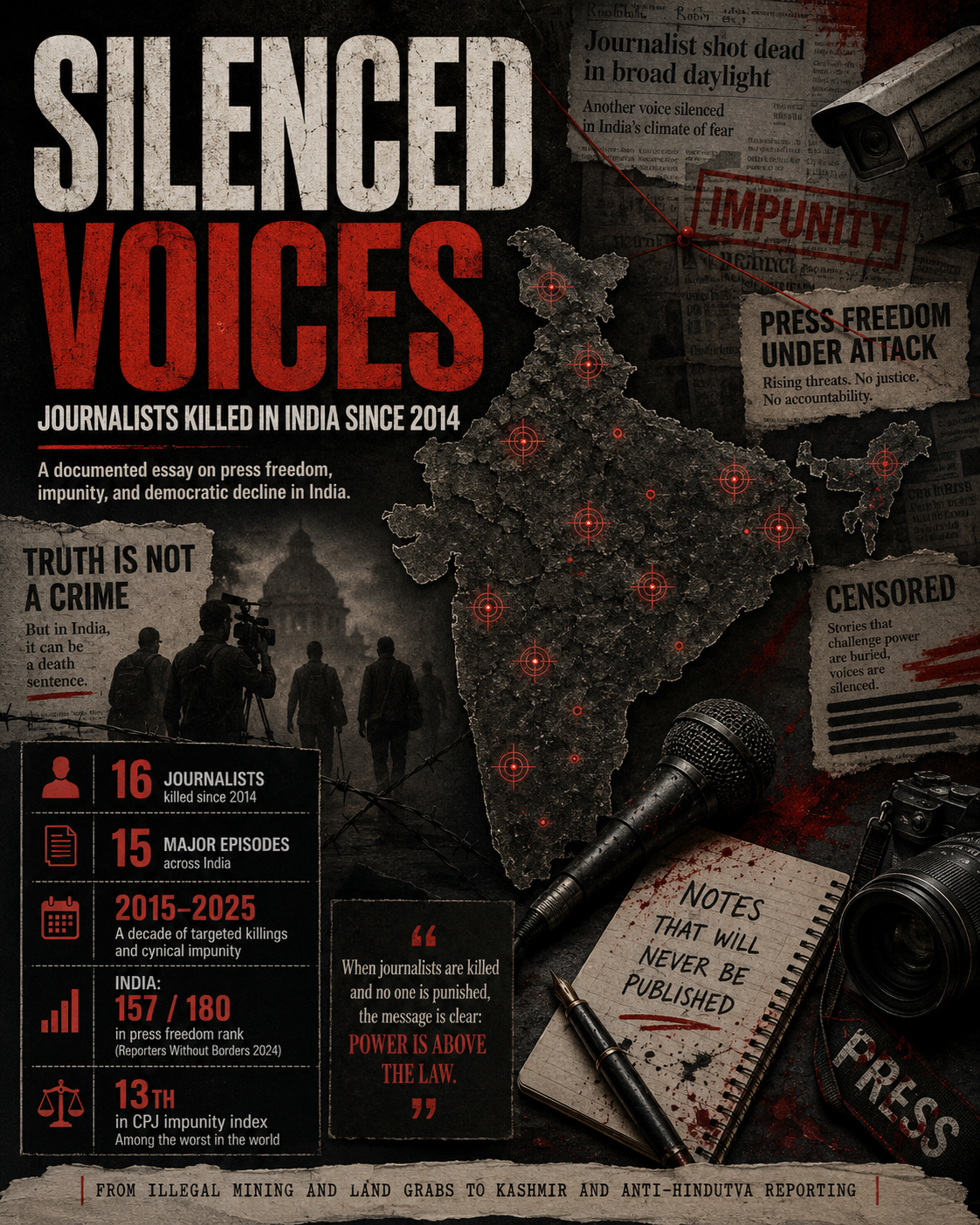
As of May 31, 2026, Reporters Without Borders ranks India 157th out of 180 countries in its World Press Freedom Index. CPJ's 2024 Global Impunity Index placed India 13th, with 19 unsolved journalist murders in the preceding decade-long window it examined. V-Dem's Democracy Report 2026 classifies India as an electoral autocracy, a far harsher judgment than the flattering democratic language still used by the Indian state.
The killings below help explain why.
Under the BJP era, reporting against ruling power has become more dangerous. Sometimes that means directly criticizing Narendra Modi, the BJP, or Hindutva networks, as Gauri Lankesh did. Sometimes it means reporting on sand mafias, land deals, police protection, sectarian tension, or contractor networks that flourish in BJP-governed states and under a wider majoritarian political order. The killings did not all come from the same immediate source. But they belong to the same climate: one in which anti-BJP, anti-Hindutva, and anti-corruption reporting carries a heavier risk than before.
The list below covers 16 journalists killed in 15 major episodes from June 2015 to January 2025. It focuses on three questions:
- Where were they killed?
- What were they reporting?
- What threats or warning signs appeared before they died?
Case Map
| Date | Journalist | Place | Reported on | Threat pattern |
|---|---|---|---|---|
| 2015-06-08 | Jagendra Singh | Shahjahanpur, Uttar Pradesh | Illegal mining and local corruption | Named a minister and police before dying |
| 2015-06 | Sandeep Kothari | Madhya Pradesh / Maharashtra border | Illegal mining and land grabbing | Repeated threats and police pressure |
| 2016-02 | Karun Misra | Uttar Pradesh | Local corruption and illegal mining allegations | Shot by motorcycle-borne assailants |
| 2016-05 | Rajdev Ranjan | Siwan, Bihar | Crime-politics nexus linked to Shahabuddin | Threats over reporting on criminal networks |
| 2017-09-05 | Gauri Lankesh | Bengaluru, Karnataka | Hindutva, caste, disinformation, minority rights | Online abuse and legal harassment before assassination |
| 2017-09-20 | Santanu Bhowmik | Mandai, Tripura | Ethnic and political clashes | Killed by a mob while on assignment |
| 2017-11 | Sudip Datta Bhaumik | Tripura State Rifles complex, Tripura | Security-force misconduct and local irregularities | Hostility tied to his reporting before he was shot |
| 2018-03-26 | Sandeep Sharma | Bhind, Madhya Pradesh | Sand mafia and police complicity | Asked for protection after explicit threats |
| 2018-03 | Navin Nischal and Vijay Singh | Bhojpur, Bihar | Local corruption and panchayat power | Run over after reporting against a village strongman |
| 2018-06-14 | Shujaat Bukhari | Srinagar, Jammu and Kashmir | Kashmir conflict, rights, and political dialogue | Lived under long-term security threat |
| 2019-10 | K Satyanarayana | East Godavari, Andhra Pradesh | Land disputes and local criminal activity | Reported threats to police shortly before death |
| 2020-06-19 | Shubham Mani Tripathi | Unnao, Uttar Pradesh | Land grabs and sand mafia activity | Told others he feared he would be killed |
| 2022-05 | Subhash Kumar Mahto | Bihar | Illegal sand mining | Shot outside his home by gunmen |
| 2023-02-06 | Shashikant Warishe | Ratnagiri, Maharashtra | Land deals and a refinery-linked conflict | Killed by the subject of his reporting |
| 2025-01 | Mukesh Chandrakar | Bijapur, Chhattisgarh | Road-construction corruption | Reporting had already triggered an official inquiry |
The Killed: Fifteen Major Episodes
1. Jagendra Singh - Shahjahanpur, Uttar Pradesh - June 2015
Jagendra Singh was a freelance journalist and blogger in Shahjahanpur, Uttar Pradesh. He wrote about illegal sand mining, corruption, and the nexus between local power and state protection. His reporting directly named influential politicians.
He died on June 8, 2015 after suffering severe burns during a police raid on his home. Before he died, he accused police and a minister of responsibility. Authorities floated the theory that he had set himself on fire. His family and press-freedom groups rejected that version. The case established an ugly template early in the Modi period: a reporter exposes local power operating under ruling-party protection, warns that danger is closing in, and the state's first instinct is to deny rather than protect.
2. Sandeep Kothari - Madhya Pradesh / Maharashtra border - June 2015
Sandeep Kothari was an investigative reporter who had been covering illegal mining, land grabbing, and the criminal networks that profit from both. He worked in the central Indian belt where mining stories routinely collide with police, contractors, and local mafias.
He was abducted, killed, and his body burned near the Maharashtra border in June 2015. CPJ reported that he had faced repeated threats and police harassment before his murder. Kothari's case matters because it showed that the danger was not confined to one state. The same combination of extractive wealth, local impunity, and state indifference was visible in Madhya Pradesh as well.
3. Karun Misra - Uttar Pradesh - February 2016
Karun Misra, a reporter for Jansandesh Times, was killed in February 2016 in Uttar Pradesh. Public reporting tied his work to allegations of corruption and illegal mining, the same local economy that had already surfaced in Jagendra Singh's killing.
He was shot by motorcycle-borne attackers, a method that would recur in later cases. The public record on documented prior warnings is thinner here than in some other murders, but the pattern is familiar: a district-level reporter investigates a protected local racket, and the reply comes in the form of quick, deniable violence carried out by men who expect to vanish back into a wider structure of impunity.
4. Rajdev Ranjan - Siwan, Bihar - May 2016
Rajdev Ranjan, the Siwan bureau chief of Hindustan, reported on the crime-politics nexus around the strongman Mohammad Shahabuddin and his network. In Bihar, this is one of the most dangerous beats a reporter can take: not abstract corruption, but specific names, patronage chains, and the violent machinery around them.
He was shot dead in May 2016 in Siwan. Reports linked the murder to anger over his coverage of criminal influence and political protection. Bihar would later produce several more journalist killings tied to local mafias and political power. Ranjan's murder remains one of the clearest examples of how district journalism in India can turn into a direct confrontation with feudal-style criminal authority.
5. Gauri Lankesh - Bengaluru, Karnataka - September 5, 2017
Gauri Lankesh was not a local corruption reporter. She was one of the country's most visible anti-Hindutva journalists. She edited Gauri Lankesh Patrike, criticized the BJP and Hindu nationalism, wrote against caste oppression and disinformation, and defended minorities and dissenters.
She was shot outside her home in Bengaluru on September 5, 2017. Before the murder, she had faced sustained online abuse, threats, and legal harassment. Her assassination is central to the argument of this essay because it stripped away the usual excuse that these are merely local criminal disputes. Here the target was openly anti-BJP, anti-Hindutva journalism. The message was not only that journalism could be punished, but that dissent from the Hindu-right political project could be marked as a public offense.
6. Santanu Bhowmik - Mandai, Tripura - September 20, 2017
Santanu Bhowmik, a young television reporter with Din Raat, was covering clashes in Tripura between rival tribal and political groups. He was only 27 and had been sent into an already explosive environment in Mandai.
He was abducted and beaten to death by a mob on September 20, 2017. This was not a classic assassination after months of investigative digging, but it still belongs in the record. When journalists are killed while covering political and ethnic violence, it reveals another democratic failure: the state cannot even secure basic reporting from the ground during politically charged unrest.
7. Sudip Datta Bhaumik - Tripura - November 2017
Sudip Datta Bhaumik, a senior journalist in Tripura, had published reports that made the Tripura State Rifles deeply uncomfortable. He was shot inside a Tripura State Rifles complex in November 2017 by a security-force constable.
The exact chain of events around the immediate confrontation was contested, but the larger pattern was not. Bhaumik's work had already generated hostility. His killing showed that danger did not come only from mafias and politicians. Security-linked institutions, too, could become intolerant of scrutiny. That matters because a democracy where reporters can be shot inside a state security compound is already far outside any serious free-press norm.
8. Sandeep Sharma - Bhind, Madhya Pradesh - March 26, 2018
Sandeep Sharma, a reporter and cameraman with the local channel News World, was investigating the sand mafia in Bhind, Madhya Pradesh. He had also alleged police complicity. Shortly before his death, he gave an interview saying he feared he would be killed and needed protection.
On March 26, 2018, a truck crushed him near his motorcycle. The suspicion from the beginning was that the collision was deliberate. Sharma's case is one of the most damning in the entire list because the warning signs were explicit. He named the danger. He warned others. The state still did nothing effective to protect him.
9. Navin Nischal and Vijay Singh - Bhojpur, Bihar - March 2018
Navin Nischal and Vijay Singh were journalists in Bihar who had reported against a powerful village figure and local corruption. In March 2018, while traveling on a motorcycle in Bhojpur district, they were run over by an SUV.
The allegation from the start was that the attack was retaliatory. These were not anonymous bystanders caught in random traffic violence. The driver was allegedly connected to the very local power structure they had exposed. Their deaths are important because they show how rural journalism in India can run headfirst into coercive local authority long before national television notices.
10. Shujaat Bukhari - Srinagar, Jammu and Kashmir - June 14, 2018
Shujaat Bukhari, editor of Rising Kashmir, was one of the most prominent journalists in the Valley. He wrote on the Kashmir conflict, human rights abuses, militancy, electoral politics, and the shrinking space for dialogue. He lived with long-term security concerns because his work displeased multiple armed and political actors.
He was shot dead outside his office in Srinagar on June 14, 2018. Bukhari's murder made a crucial point. Even fame, international recognition, and prior security did not guarantee protection. If a nationally known editor covering Kashmir could be killed in broad daylight, the warning to less visible reporters was obvious.
11. K Satyanarayana - East Godavari, Andhra Pradesh - October 2019
K Satyanarayana, a reporter with Andhra Jyothy, covered land disputes and local criminal activity in East Godavari district. According to reporting at the time, he had informed police about threats from people angered by his stories.
He was killed in October 2019. The importance of his case lies in the repetition of a now familiar sequence: a local reporter takes on land interests and anti-social elements, alerts the police, and is murdered anyway. The institutional response is reactive, not preventive. The republic notices only after the body appears.
12. Shubham Mani Tripathi - Unnao, Uttar Pradesh - June 19, 2020
Shubham Mani Tripathi, a reporter for Kampu Mail, had been investigating land grabbing and illegal sand mining in Uttar Pradesh. Before he was killed, he told others that he feared for his life because of his reporting.
He was shot dead in Unnao district on June 19, 2020. RSF later cited his case as another example of India's failure to protect reporters who clearly warn that they are in danger. This is one of the most revealing features of the Indian pattern: the murders are not always surprises. Often the victim has already said, in plain language, that danger is coming.
13. Subhash Kumar Mahto - Bihar - May 2022
Subhash Kumar Mahto was a freelance reporter in Bihar known for exposing illegal sand mining. That beat had already claimed multiple journalists in north India, yet the state still had no credible protective architecture for reporters working on it.
He was shot dead outside his home in May 2022. The public record is thinner on specific prior warnings than in the cases of Sharma or Tripathi, but the structural threat was obvious. By this point, any journalist reporting on illegal sand extraction in Bihar or Uttar Pradesh was operating inside a plainly lethal environment.
14. Shashikant Warishe - Ratnagiri, Maharashtra - February 6, 2023
Shashikant Warishe was an investigative journalist in Maharashtra who reported on land disputes, local political economy, and a refinery-linked conflict in Ratnagiri. His reporting named a land dealer and challenged the interests surrounding large development politics on the Konkan coast.
On February 6, 2023, he was allegedly run over by the very man he had written about. This was retaliation stripped of any need for disguise. Warishe's case is especially stark because it joined motive and method almost too neatly: the subject of the report became the killer.
15. Mukesh Chandrakar - Bijapur, Chhattisgarh - January 2025
Mukesh Chandrakar, a Bastar-based freelance journalist and YouTuber, investigated corruption in a road-construction project in Bijapur, Chhattisgarh. His reporting was serious enough that it had already triggered an official inquiry.
He disappeared at the start of January 2025. Soon after, his body was found in a septic tank. Several arrests followed, but the killing still stands as a brutal reminder of how dangerous reporting is in India's underreported interior regions. Chandrakar's murder corrected one false comfort people often keep: that only obscure local quarrels turn deadly. In his case, journalism had already reached the level of official scrutiny, and that still did not save him.
What the Pattern Actually Shows
The first pattern is geographic. Uttar Pradesh, Bihar, and Madhya Pradesh recur because they combine weak law enforcement, extractive local economies, criminalized politics, and reporters who often work without institutional backing. These are not accidents of geography. They are the predictable result of governance environments in which local elites can buy time, dilute investigations, or intimidate witnesses.
The second pattern is thematic. The deadliest beats were:
- illegal sand mining,
- land grabs and real-estate disputes,
- criminal-political protection rackets,
- security-force scrutiny,
- Kashmir,
- and criticism of Hindu majoritarian politics.
In modern India, reporting against BJP power often does not arrive wearing a BJP label. It appears as a story on sand extraction protected by police. It appears as a story on land acquisition, sectarian mobilization, or a local contractor with political patrons. It appears as a story on the Hindu right's disinformation machine or on rights abuses in Kashmir. Many of the reporters killed in these cases were threatening the political order the BJP era has entrenched even when their articles were framed as local investigations.
The third pattern is the one that should shame the state most: warning ignored. Jagendra Singh, Sandeep Kothari, Sandeep Sharma, K Satyanarayana, and Shubham Mani Tripathi all fit the broad template of danger being visible before death. Some named possible enemies. Some had already clashed with officials or strongmen. Some told colleagues or police they feared attack. The system did not protect them.
The fourth pattern is method. Gunmen on motorcycles. Vehicles used as weapons. Burning bodies. Executions outside homes. Murders after reporters are isolated from large national attention. This is not ordinary crime. It is a disciplined culture of intimidation directed at people whose work threatens revenue, reputation, or ideological control.
Why Reporting Against BJP Power Has Become More Dangerous
Not every journalist in this list was killed by a BJP worker or a Hindutva cadre. But it is just as misleading to describe these murders as politically neutral local crimes.
Journalists who report against the BJP are especially vulnerable in today's India for three reasons.
First, in some cases the ideological link is direct. Gauri Lankesh was killed after years of criticism of the BJP and the Hindu right and after sustained online abuse from that ecosystem. Journalists covering anti-Muslim violence, caste oppression, Hindutva politics, or democratic backsliding now work in a country where the ruling party and its wider ecosystem routinely brand critics as anti-national, corrupt, or civilizational enemies.
Second, even where the immediate killers were mafias or local strongmen, the broader political climate still matters. In BJP-ruled states especially, anti-corruption reporting often means reporting against the very local ecosystem through which ruling-party power is exercised: police protection, contractor networks, mining interests, land dealers, and communal mobilizers. A government that treats critical journalism as hostile activity teaches officials, party workers, and local allies to see reporters not as watchdogs but as obstacles. That lowers the social cost of attacking them.
Third, Hindu majoritarian politics has transformed the public language around dissent. Once journalists, students, minority activists, and opposition voices can all be described as enemies of the nation, anti-Hindu, urban Naxals, or foreign agents, physical violence becomes easier to rationalize and institutional protection becomes easier to withhold. This matters even in murders that look "local" on the surface, because the larger regime has already trained the public to distrust the victim more than the powerful.
This is why the killings of anti-corruption reporters in Uttar Pradesh and Bihar belong in the same larger essay as the assassination of Gauri Lankesh. The immediate motives are not identical. But many of these reporters were still, in substance, reporting against BJP power: against the local machinery, local impunity, and local ideological atmosphere that the BJP era has rewarded or failed to restrain. The democratic lesson is the same.
Democracy In Name, Fear In Practice
India still has elections. That is the formal defense always offered when people call the system authoritarian.
But democracy is not only the right to vote every five years. It also requires:
- a press that can investigate power without being killed,
- police that act before murder rather than after headlines,
- courts that impose real costs on those who silence journalists,
- and a political culture that treats criticism as legitimate rather than treasonous.
On those measures, the record is grim.
RSF's 157th-place ranking in 2026 is not a cosmetic embarrassment. CPJ's 13th-place impunity ranking in 2024 is not an international misunderstanding. V-Dem's electoral-autocracy classification is not a rhetorical flourish. Taken together, they describe a country that retains democratic architecture while steadily weakening democratic substance. They also point to a harsher political reality: in the BJP era, journalism that challenges the ruling order has become meaningfully more dangerous.
The problem is not only the murder of journalists. It is the wider system that surrounds those murders:
- criminal defamation,
- UAPA and other coercive laws,
- online harassment networks,
- ownership capture by politically aligned corporate interests,
- police unwillingness to protect vulnerable reporters,
- and years of failed prosecution after killings.
That is why the phrase "democracy only in name" has more force in India today than the state would like to admit. Elections continue. Fear does too.
What This Means For Ordinary Indians
The danger to journalists is not an issue limited to journalists.
If a reporter who publicly names his likely killers can still be run over, shot, burned, or disappeared, then the ordinary citizen with no platform is even less protected. The same state that fails to defend journalists also fails farmers in land disputes, workers facing police abuse, minorities facing collective punishment, and undertrials trapped in a slow criminal process.
The attack on the press is therefore not a side story. It is one way the state reveals its character.
When watchdogs are silenced, ordinary people lose witnesses.
Conclusion
These killings should not be remembered as disconnected local tragedies. They form a pattern.
The pattern is that reporters who challenge the ruling order in India increasingly do so without meaningful institutional protection. Sometimes that challenge is explicit criticism of the BJP or Hindutva. Sometimes it is exposure of the local corruption, criminal patronage, police complicity, or sectarian machinery through which BJP-era power is exercised. The pattern is that murder is followed too often by delay, dilution, and impunity.
The conclusion is not merely that press freedom is under strain. It is that India has become a state in which reporting against the ruling order can carry mortal risk while the institutions meant to protect journalists remain weak, selective, or complicit. It still performs elections, but it protects neither truth-tellers nor the public's right to know with the seriousness a real democracy requires.
And when journalism becomes a profession in which warning the state about your danger still does not save you, the problem is no longer only media freedom.
It is the nature of the regime itself.
Further Cases That Also Belong In The Wider Record
This essay focused on a conservative core of targeted murders and clearly documented killings. It is not the full story. Other cases from the same period, including journalists killed while covering violent events or dying in suspicious circumstances, deepen the same concern. Examples often cited by press-freedom groups include Raman Kashyap in Lakhimpur Kheri in 2021 and Rohit Kumar Biswal in Odisha in 2022.
That broader record makes the central conclusion stronger, not weaker.